

Nearly a decade after the 2016 peace deal with FARC, Colombia shows that ending conflict does not ensure sustainable peace. Former fighters continue to face insecurity, stigma, and unstable livelihoods. Reintegration remains incomplete, as fundamental human needs (safety, acceptance, and self-determination) are unevenly met in everyday life.
Backstory
Peace on Paper, Uncertainty in Practice: Life After FARC
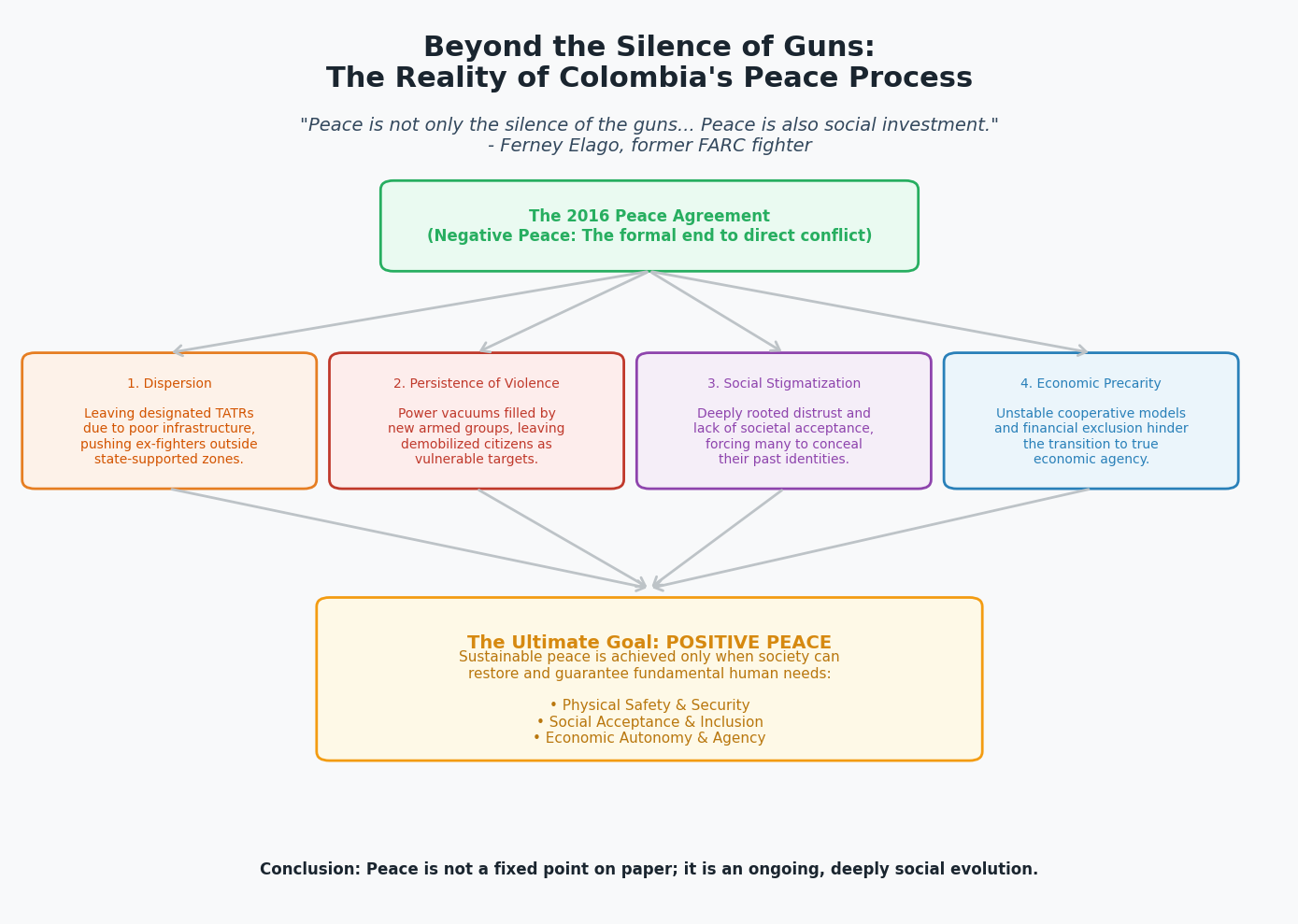
“Peace is not only the silence of the guns… Peace is also social investment. Peace is generated employment. Peace is development.” - Ferney Elago, a 33-year-old former FARC fighter. (Morales 2022, 7)
After five decades of one of the longest-running armed conflicts in modern history, the Colombian government and Revolutionary Armed Forces of Colombia (FARC) signed a 2016 peace agreement that formally ended fighting and committed to transitioning from war to peace, from instability to reconstruction, and from rebellion to citizenship. Formally, the framing holds, ending the conflict and demobilizing close to 14,000 fighters and establishing institutional mechanisms supported by the UN and EU such as the European Union Trust Fund for Colombia and the Agency for Reintegration and Normalization (ARN) to support recovery, stabilization, and reintegration post conflict (ICG 2021, 2) (EEAS 2016, 1). Such efforts depict a clear halt to armed conflict. However, to treat this formal agreement as a definitive end to all forms of violence and instability, is a large misjudgement. Nearly a decade later, Colombia illustrates this reality to be more complicated; its peace is ongoing, uneven, and social, and cannot be reduced to political design. So, how is the illusion of peace actually experienced now? Is it meeting fundamental human needs that make peace sustainable? What does it reveal about human nature?
Colombia is often presented as a post-conflict success story. However, its lingering effects and social fractures still shape everyday life, particularly for those trying to transition and reintegrate. For former FARC members, reintegration and acceptance into society has proved scarce and uneven.
From Demobilization to Dispersion
As part of the reintegration program, former fighters were settled in designated Territorial Areas for Training and Reintegration (TATRs), accessing programmes of education (academic and vocational) and state support (ReliefWeb 2018, 1). They served to help with citizen transition and reintegration, allowing a supported shift from armed life to civilian identity. Despite initial successes, the system suffered from poor infrastructure, limited funding, and security concerns. With limited viable economic opportunities within the zones, most participants left, ultimately hindering the conditions of reintegration (Suárez 2024, 3); by 2024, the majority of former members lived outside such zones, being dispersed across different cities, with only about 16% remaining on site (Sabogal 2024, 609). Consequently, without direct support, reintegration becomes contingent and dependent on variant factors depending on region and presence (or often, absence) of state institutions. In some areas, cooperative projects such as farms employing ex-fighters and other structures have created relative stability. However, in others, they face similar structural inequalities that caused the conflict in the first place. Therefore, stability is no longer dependent on existing structures named in the peace agreement and is instead shaped by where individuals end up and what resources are available.
Persistence of Violence After “Peace”
Despite cited demobilization and terminance of violence, security after war remains scarce. With the dismantling of FARC and direct conflict between the state and the group, power vacuums emerged, now being filled by other dissident groups and criminal organizations such as the National Liberation Army (ELN) and the Gulf Clan (AGC) (Helen 2018, 2). This has directly affected former combatants, with over 460 being victims of targeted murders, forcing them out of TATRs, endangering, and displacing them (Sponsel 2023, 2). With delays in housing displaced ex-fighters, many became, according to ex-rebel, Antonio Pardo, “sitting ducks for other armed groups looking to settle old scores,” stating that “there were failures on the part of the government, failures they described as delays. But those delays could be deadly for us,” (Buschschlüter 2022, 3). As community spokesperson Jasbleidy Cabana explains, “the dissidents see us as traitors to Farc’s struggle,” making them victims of persisted violence beyond formal peace (Sponsel 2023, 2). This depicts how the assumption of demobilization leading to security is flawed, and rather makes citizens vulnerable in a society where they are no longer fighters but not fully protected civilians either. Although the war has ended at a national level, the basic human need for security is uncertain for these populations. Peace is not sustainable when safety is inadequate.
The Social Limits of Reintegration
“Most people don’t want us to work for them, because of what we were,” (Brigida 2016, 2). Alongside challenges in security, former members struggle to be accepted into society. Post-conflict transition policies and programs often focus on logistical aspects of reintegration, paying little attention to social inclusion and assuming that economic participation will facilitate reintegration into society. While this assumption is in part valid, it underestimates the depth of social fracturing produced by prolonged and violent conflict which hinders reconciliation. The five decade long conflict has significantly damaged communities, causing collective loss and destabilization. Consequently, distrust is a lived reality between conflict-affected communities and former fighters. Former members face large stigmatization, threats, distrust, and struggle to be accepted into their communities. According to a 2025 Harvard survey, “many choose to conceal their past for fear of being excluded,” and that “70% of respondents report (...) risks tied to their reincorporation, and threats against themselves and their families,” (Duque 2025, 11).
Thus, reintegration must recognize such struggles and focus on policies beyond economic productivity. They must engage with “families, receiving communities, and society,” to provide resources and use “dialogue, compensation, guarantee of nonrepetition, and acknowledgement and repentance for the damage done” in order to create “an atmosphere of acceptance to ensure there are opportunities for former combatants to reintegrate,” (Gluecker 2021, 361, 270). Overall, the human need for acceptance is not easily restored from policy, and requires social interaction and time. Therefore, formal reintegration programs still leave transitioners vulnerable. Sustainable peace does not exist when society does not accept them.
Economic Reintegration and the Search For Agency
Efforts to support economic reintegration have often come unevenly and perpetuate structural inequality. Despite efforts of workforce inclusion, through systems such as Economía Social del Común (ECOMUN), a cooperative with the aim of promoting “the reintegration of former combatants into territories through their cooperatives and associations,” its focus on access to economic activity rather than access to functioning and stable economic systems has limited the development of sustainable and autonomous lives. Although businesses exist, they are unstable and have difficulties generating stable incomes. In agricultural areas, cooperative projects such as farms employing ex-fighters lack sustainable incomes due to fluctuating harvest cycles, prices, social stigma, and inconsistencies (Morales 2022, 6, 7)(Duque 2025, 11). In others, irregular demand, weak value chain positioning, low investment, and an overall lack of social acceptance continuously undermine stability and long-term viability, forcing many to rely on precarious, short-term income strategies with unpredictable income and revert to illegal sectors such as drug trade (Otis 2021, 3). Additionally, former fighters also face systemic barriers associated with financial exclusion, with restricted access to banking services, stigma preventing economic reintegration in communities, and struggles to access “important financial services such as credit and loans,” (Valencia 2022, 3). Moreover, economic focus on efficiency ignores post-conflict realities, where participation is shaped by insecurity, trauma, and health conditions. While programs enable participation and provide some level of income, transition to independent economic actors is not consistently stable; income and market integration remains limited, irregular, and dependent on cooperative structures. Thus, Colombia’s reintegration model hinders self-determination, as agency depends on not only access to work, but the capacity to exercise economic autonomy and stability.
From Distance to Reality
At first glance, the issue may feel geographically, politically, and socially distant to readers. Despite the specific focus on post-conflict Colombia and its effects on ex-FARC members, its dynamics and what it reveals is familiar. The search for safety, acceptance, stable sense of identity, and agency are not unique to post-conflict societies. Despite different contexts, these human needs are in reality, universal. Furthermore, the focus is not only Colombia’s process of rebuilding after long conflict, but what it reveals about real peace, institutions, and human nature universally. The idea of ‘peace on paper, uncertainty in reality’ is present in various different contexts such as, for example, the failure of a simple ceasefire in Syria that did not address key grievances. Peace, therefore, is not about only ending direct violence, but about restoring basic human needs and conditions.
Conclusion
Historically, in fragile and post-conflict societies, it is evident that solely stopping physical harm (through methods of ending conflicts by ceasefires or peace agreements), does not prevent instability, resentment, grievances, or renewal of conflict. In 2015, a survey of scholars identified key elements of sustainable stability beyond violence: well-being, quality of social relations, cooperation, interdependence, access to resources, equality, and human security (Coleman 2020, 4). It is important, therefore, to address all aspects of peace when peacekeeping.
Nearly a decade after the 2016 agreement, Colombia illustrates the complexity of post-conflict recovery and peacebuilding. For former FARC members, progress is evident, but is not complete, involving continuously navigating unstable and uncertain conditions. Reintegration and peace does not occur within a defined timeframe as it deals with deep-rooted societal transformations. Overall, it is evident that peace cannot be fully achieved with a single document or moment. It requires the implementation of “positive peace”, otherwise known as the creation of sustainable, harmonious societies beyond the mere absence of war through attitudes, institutions, and resolution of root grievances (Positive Peace n.d., 1). It is within this condition where human needs such as safety, acceptance, and self-determination are met.
Sources:
Brigida, Anna-Catherine. “Turning Guerrilla Fighters into Entrepreneurs.” BBC News, March 24, 2016. https://www.bbc.com/news/business-35873206
Buschschlüter, Vanessa. “Colombia Ex-Fighters Brew up New Lives After Giving up Guns.” BBC News, April 7, 2022. https://www.bbc.com/news/world-latin-america-60993769
Coleman, Peter T., Joshua Fisher, Douglas P. Fry, Larry S. Liebovitch, Allegra Chen-Carrel, and Geneviève Souillac. “How to Live in Peace? Mapping the Science of Sustaining Peace: A Progress Report.” American Psychologist 76, no. 7 (November 12, 2020): 1113–27. https://doi.org/10.1037/amp0000745
Colombia, UN Verification Mission in. “Former FARC-EP Members Are Transforming Their Lives with Education.” ReliefWeb, July 27, 2018. https://reliefweb.int/report/colombia/former-farc-ep-members-are-transforming-their-lives-education
Duque, Juana Garcia. “Peace Advancements and Challenges in Colombia.” ReVista, January 27, 2025. https://revista.drclas.harvard.edu/peace-advancements-and-challenges-in-colombia/
European External Action Service (EEAS). “EU Trust Fund for Colombia.” December 12, 2016. https://www.eeas.europa.eu/node/16984_es
Gluecker, Andreas, Andrea Correa-Chica, and Wilson López-López. “The FARC in Colombia: Collective Reintegration and Social Identity Transformation.” Political Psychology 43, no. 2 (May 20, 2021): 359–74. https://doi.org/10.1111/pops.12765
Helen, Murphy, and Luis Jaime Acosta. “Violent Rivals Rush into FARC Void in Colombia: A Fractured Peace.” Reuters Investigates, April 26, 2018. https://www.reuters.com/investigates/special-report/colombia-peace/
International Crisis Group. A Fight by Other Means: Keeping the Peace with Colombia’s FARC. November 30, 2021. https://www.crisisgroup.org/rpt/latin-america-caribbean/colombia/092-fight-other-means-keeping-peace-colombias-farc
Morales, Mauricio. “From Fighting to Farming: Colombia’s Ex-FARC Seek Alternatives to War.” The New Humanitarian, December 7, 2022. https://www.thenewhumanitarian.org/news-feature/2022/12/07/Colombia-FARC-alternatives-peace-guerrilla
Otis, John. “Many of Colombia’s Ex-Rebel Fighters Rearm and Turn to Illegal Drug Trade.” WHQR, April 9, 2021. https://www.whqr.org/2020-05-19/many-of-colombias-ex-rebel-fighters-rearm-and-turn-to-illegal-drug-trade
Positive Peace. “What Is Positive Peace?” n.d. https://positivepeace.org/what-is-positive-peace
Sabogal, Laura Camila Barrios. “From Cantonments to Settlements: Lessons for Reintegration of Former Combatants from the Colombian Peace Process.” International Peacekeeping 31, no. 5 (August 27, 2024): 599–637. https://doi.org/10.1080/13533312.2024.2391765
Sponsel, Christoph. “Colombia: Former FARC Fighters Who Signed 2016 Peace Deal Now Live amid Threats and Assassinations.” The Conversation, September 7, 2023. https://doi.org/10.64628/ab.ck4eav3s7
Suárez, Astrid. “Dozens of Former FARC Fighters Abandon ‘Reincorporation’ Village in Colombia after Death Threats.” AP News, August 21, 2024. https://apnews.com/article/farc-colombia-displaced-former-fighters-1bd52aebb43e3464cdb7570c531dad43
Valencia B., Wilson. “Barriers to Entry: Understanding Labor Market Attitudes towards Ex-Combatants and How the Private Sector Can Help.” 2022. https://revistas.javeriana.edu.co/files-articulos/PaPo/27%20%282022%29/77772006009/index.html
In this episode Anh discusses the Vietnamese expereince of rebuolding their country and the kind issues they have been dealing with. She is a Citizen journalist with us on a placement organised with Department of War Studies, King’s College, London.
Thank you for reading an A4R 🎨 Post. Don’t forget to try out gaming art NFT’s here. Every purchase scales our impact and pays our bills.


