


Memoricide in Nagorno-Karabakh: the Fading Identity of the Artsakhtsi
They fled Nagorno-Karabakh, buried loved ones, and rebuilt lives from scratch, eventually gaining citizenship, housing, and work. Now a new threat looms for the Artsakh people: the deliberate erasure of their cultural history. Towns are being renamed, sacred sites destroyed, and with those losses the region’s distinct dialect risks vanishing within a generation. This is a memoricide, a killing of Artsakh history, delegitimising the claims of these people to their homeland.
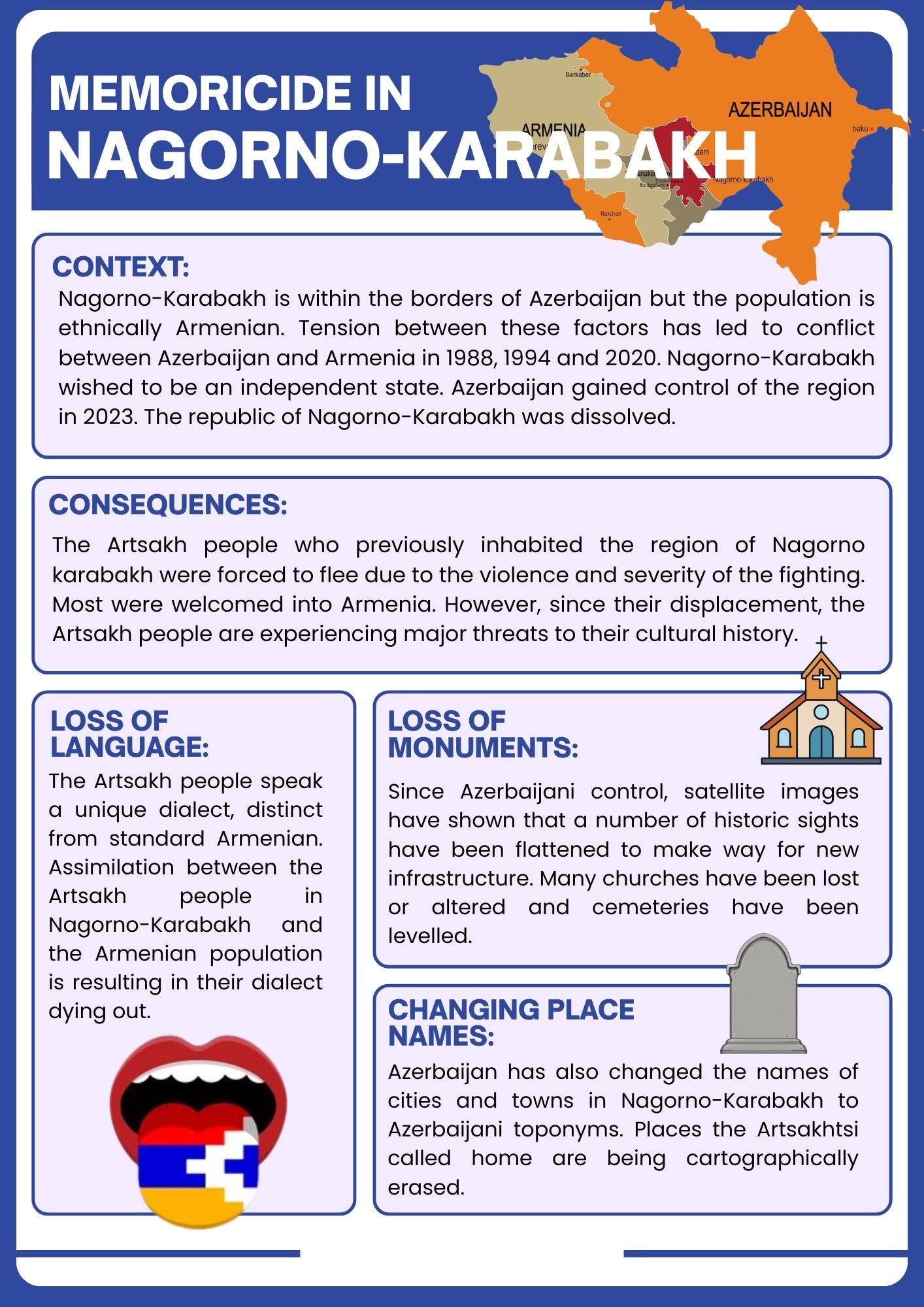
The Nagorno-Karabakh region is an ethnically Armenian enclave located within the internationally recognized borders of Azerbaijan. Its Artsakh population, which uses a local Armenian dialect, has long identified culturally and politically with Armenia rather than Azerbaijan. That divergence between the inhabitants’ identity and the region’s geographic position has been a central source of tension between Armenia and Azerbaijan, contributing to repeated conflicts over control of the area.
Under Soviet rule, Nagorno-Karabakh was placed within the Azerbaijan Soviet Socialist Republic as the Nagorno-Karabakh Autonomous Oblast. In 1988, the region’s ethnic Armenian population began pressing for transfer of the oblast to Armenian jurisdiction; that demand was opposed by both Azerbaijani authorities and the Soviet government. After the Soviet Union collapsed, Armenia and Azerbaijan fought a full-scale war. In the 1990s, forces from Nagorno-Karabakh and Armenia took control of much of southwestern Azerbaijan, including Nagorno-Karabakh and a land corridor linking it to Armenia. A ceasefire followed, but negotiations produced no lasting settlement; the region’s authorities then declared the Republic of Nagorno-Karabakh, a state that no UN member recognized.
Azerbaijan, supported by Turkey, renewed large-scale fighting in 2020, producing the worst clashes since the early 1990s. Armenian forces suffered heavy losses, and a ceasefire was soon arranged that significantly curtailed Armenian military presence in parts of the disputed area. A further Azerbaijani offensive in 2023 consolidated control: by then more than 100,000 Artsakh people had fled and the self-declared Republic of Nagorno-Karabakh (also known as the Republic of Artsakh) announced its dissolution. No comprehensive peace treaty has been signed; both sides accuse the other of ethnic cleansing, and Azerbaijan says it will not agree to any deal it believes legitimizes Armenian claims to the territory.
The exodus of the Artsakh people from Nagorno-Karabakh is considered one of the most complete displacements in human history. Most found refuge in Armenia, yet further challenges still plagued refugees. Secure, affordable housing is scarce as rents rise under increased demand; legal status and citizenship, essential for stable employment and access to services, are often slow to come. Many have depleted their life’s savings in funding their flight and many report feeling a slight tension with the Armenian population over the added pressure on public services.
Integration with the wider Armenian population is vital if Artsakh refugees wish to re-build their lives; but it comes with a hidden cost. Refugees from Nagorno-Karabakh brought with them a unique dialect, distinct to the Artsakh people. It bears similarities to standard Armenian, but this dialect is now confined to the homes of refugees. While Artsakh people from Nagorno-Karabakh try to keep it alive at home, podcast host Tatevik Khachatryan says that words from the Yerevan (Armenian) dialect are being added to her son’s vocabulary. Education in Armenian schools means that Artsakh children are less able to use their dialect and face the possibility of teasing from other children. As the Artsakh people and the wider Armenian population assimilate, it is likely that the dialect will disappear altogether.
That loss would be more than linguistic. Known as “Mer lyuzun”, our language, by Artsakhtsi, the dialect has ancient roots. It preserves words of classical Armenian missing from the standard tongue, and contains unique sounds and loanwords picked up from neighbouring countries. For people from Nagorno-Karabakh, the Artsakhtsi, this language is a living memory and a source of pride. Losing it would mean losing a piece of identity and those words and expressions which bind their people together.
Language is only one casualty of a wider cultural erasure facing the Artsakhtsi. Their religious sites, monuments and burial grounds, tangible anchors of memory and identity, are being systematically destroyed and replaced. Since Azerbaijani authorities assumed control of the region, satellite imagery has documented the flattening of sacred places: Kanach Zham Church in Shusha lay in ruins, St. Sargis Church in Mokhrenes has been razed and new construction is already emerging. Historic cemeteries in Shusha and the village of Mets Tagher have suffered the same fate; even tombstones have been removed to make room for infrastructure, severing visible links to generations past.
Armenia has a strong Christian identity, claiming to be the first nation in the world to adopt Christianity in 301AD. The reported destruction of historic churches erases their long communal memory. These structures have provided centres for Artsakh communities for generations, holding memories of years and years’ worth of marriages, baptisms, funerals, and festivals. For the displaced people of Artsakh, losing these sites and being having no means to protect them is another step towards cultural identity loss, making the reality of returning increasingly uncertain. If they went back, would they even recognise their homeland?
Beyond the loss of monuments, Artsakh family history is being erased through the removal of tombstones and cemeteries. The heartbreaking reality is that as well as wondering whether their homes still stand; refugees worry that graves of loved ones have been destroyed. Tombstones testify to a family’s continued presence in an area, demonstrating the deep ties to their homeland. The destruction of cemeteries like those in Shusha removes the ability to trace family history or to pay respects to those who have passed away and is just another way in which physical traces of the Artsakh people’s presence in the region of Nagorno-Karabakh are being eradicated.
If Artsakhtsi were to return to Nagorno-Karabakh today, they would find their homeland profoundly altered. Many familiar places have been renamed with Azerbaijani toponyms. Stepanakert, once known for its 19th-century Armenian architecture, has been physically reshaped by new buildings and roads and is now referred to as Khankendi (Azerbaijani: Xankəndi). Stepanakert originally took its name from the Bolshevik revolutionary Stepan Shaumian; removing the name serves to delete erase the history of that place, rendering the past of the Artsakhtsi invisible; it severs the linguistic and historical link between the land and its former inhabitants.
The effects of these changes are profound. Artsakh refugees are finding that the place they considered home can no longer even be found on their documents. Aren Hayrapetyan, a displaced Artsakh, received Armenian citizenship but was horrified when he found that his birthplace was listed as “Azerbaijan”. He says that this is an incorrect reflection of his identity, and he will not swear allegiance to Armenia while his documents label him Azerbaijani. For Aren, seeing ‘Azerbaijan’ on his official documents feels like a state-sanctioned eviction from his homeland, as if the Armenian authorities seek to formalise his displacement.
The home of the Artsakh people no longer exists, it has been systematically renamed, and the places they once knew and loved have been destroyed. Traces of ancestral presence are being wiped out through the destruction of cemeteries, and new infrastructure, part of the ‘smart cities’ project, is replacing it. Nagorno-Karabakh is becoming unrecognisable. Not only is the region which lives in the memory of the Artsakh people is no longer their home on paper, it no longer physically exists. The survival of their cultural history is in jeopardy, further worsened by the inevitable loss of their unique Artsakh dialect, which is already becoming redundant, being supplanted in favour of standard Armenian.
There is hope, however. Several programmes are being developed to salvage cultural memory where possible. TUMO’s Armenian Cultural Heritage Institute, launched in early 2026 uses 3D scans of Artsakh monuments to create virtual reality experiences for refugees and researchers. A similar programme attempts to preserve the “architectural DNA” of the region, to ensure that the proportions of buildings and many of their unique carvings can be preserved and reconstructed in the future. The “We Exist” initiative held a major festival in January of this year to celebrate Artsakh culture, featuring carpet weavers and chefs, to ensure that their “intangible” heritage, like Zhengyalov hats (stuffed flatbread) survives. Furthermore, podcasts and oral-history projects are recording Artsakh dialect before it dies out.
The Artsakh people are fighting their cultural erasure. Their efforts demonstrate their resilience and will to survive. While the physical presence of their homeland may be being altered, digital records form a cultural archive, an indestructible record of cultural history. Likewise, making use of oral records and popular media such as podcasting will continue to make Artsakh dialect accessible to young people. Celebrations of Artsakh culture within Armenia are testament to its living force and ability to reform a broken community. There may be efforts to erase this culture, but the spirit of those who carry it with them are not letting it disappear.

In this episode Harriet discusses the post conflict experience of the Artsakh people of Nagorno-Karabakh. She highligts life after the war there. She is a Citizen journalist with us on a placement organised with Oxford University Career Services.
Thank you for reading an A4R 🎨 Post. Don’t forget to try out gaming art NFT’s here. Every purchase scales our impact and pays our bills.


