


Measuring Peace Beyond Conflict: Women’s Recovery in Post-War Ethiopia
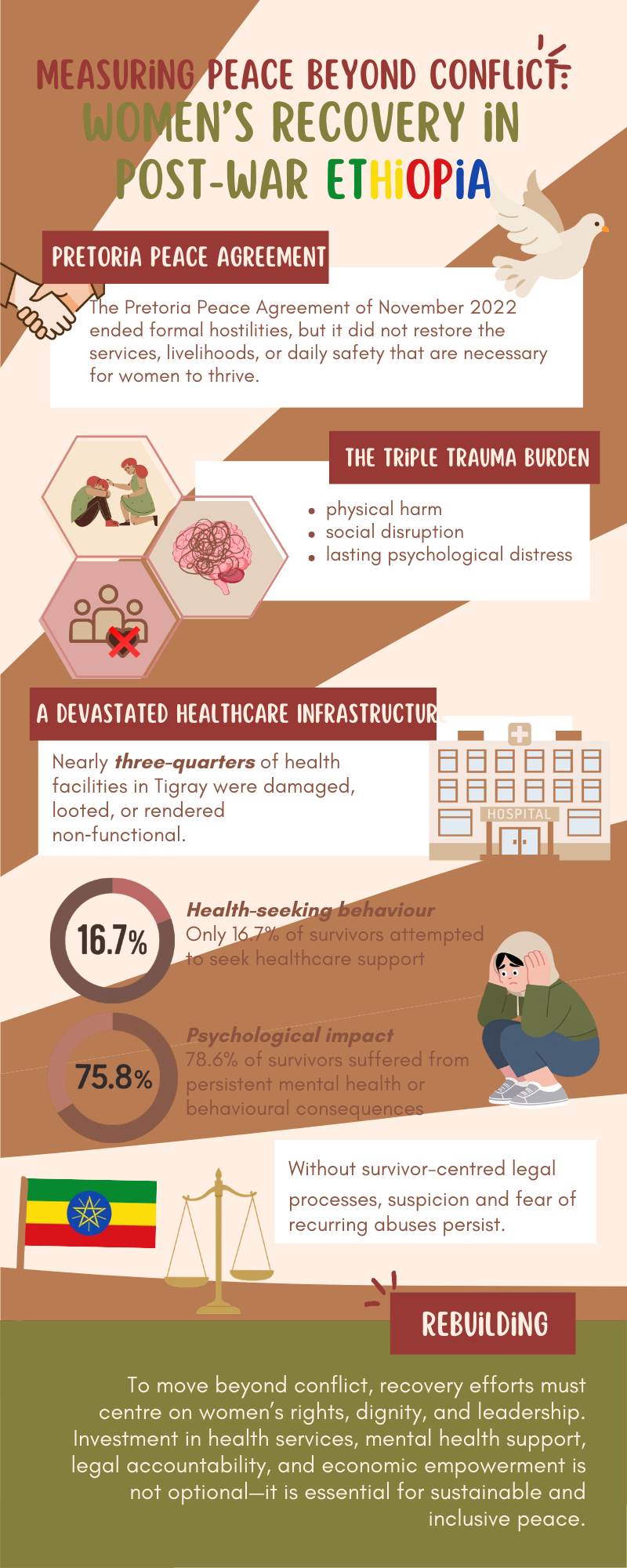
In a makeshift clinic in Mekelle, a woman waits three hours for care for a wound that never healed during the fighting. The Pretoria Peace Agreement of November 2022 ended formal hostilities, but it did not restore the services, livelihoods, or daily safety that make life livable. For many women in Tigray and neighbouring regions, the ceasefire marked the start of a different fight: regaining access to healthcare, justice, social belonging, and economic stability. The transition from war to peace has therefore been uneven and deeply gendered, revealing how the end of violence does not automatically lead to recovery.
Post-conflict recovery is often framed in political or military terms. Sustainable peace is not. It is measured at the household and community level: can a woman seek medical care without fear, secure legal recognition for abuses she suffered, find work that supports her family, and be welcomed back into community life? These everyday questions capture the lived experience of peace more accurately than diplomatic milestones or ceasefire monitoring reports. For women in northern Ethiopia, the answer remains: not yet. The gap between formal peace and lived security continues to shape daily life, limiting the potential for long-term stability and reconciliation.
Health and bodily integrity
The physical toll of the war is visible and ongoing. Nearly three-quarters of health facilities in Tigray were damaged, looted, or rendered non-functional. As a consequence, many survivors live with untreated injuries, obstetric complications, and heightened risk of sexually transmitted infections. Women who were pregnant or gave birth during the conflict often lacked skilled medical support, increasing long-term maternal and infant health risks. In rural areas, distances to functioning clinics remain significant, and transport costs or insecurity continue to prevent access.
One striking estimate from post-conflict assessments found that roughly three quarters of documented sexual-violence survivors did not receive timely medical support. Those numbers are not abstract; they are wounds that complicate childbirth, make daily work harder, and carry stigma. Untreated injuries and chronic pain also reduce women’s capacity to work, care for children, and participate in community life. Rebuilding health systems is therefore not only a humanitarian priority but a foundation for recovery, economic participation, and dignity.
Mental health and social reintegration
Psychological harm is equally persistent. Clinicians and NGOs report elevated levels of insomnia, panic, intrusive memories, and social withdrawal among survivors. In areas where mental-health services are scarce, trauma becomes a quiet engine of social breakdown: people withdraw from reciprocal networks, caregivers burn out, and children grow up in households without emotional repair. The intergenerational impact of trauma is particularly concerning, as unresolved distress may shape the wellbeing and socialisation of children for years to come.
Addressing mental health is not an optional add-on; it is essential to restoring the capacity to work, parent, and participate in community life. Community-based support, peer counselling, and culturally appropriate healing approaches are especially important in contexts where formal services are limited. Strengthening these systems can rebuild trust and help restore the social fabric damaged during conflict.
Justice, accountability, and trust
Health without justice leaves many survivors exposed to continuing harm. Without transparent investigations, survivor-centred legal processes, and reparations, suspicion and impunity persist. Reports of renewed localised violence in Amhara and Afar have deepened fears that abuses could recur beyond Tigray, eroding confidence in the peace process. Survivors may be reluctant to report violations if they believe that perpetrators will not be held accountable or that doing so may expose them to retaliation.
Practical justice must include medical-legal referral pathways, access to legal aid, protection for witnesses, and support for community dialogues that centre survivors’ rights and choices. Equally important is the recognition that justice processes should prioritise dignity, confidentiality, and agency. When survivors feel heard and protected, trust in institutions can gradually be rebuilt, contributing to reconciliation and long-term peace.
Social belonging and information harms
Recovery is social as much as infrastructural. Survivors frequently face stigma, shaming, or forced silence. These dynamics can isolate women from their families and communities, undermining their ability to rebuild their lives. In some contexts, women may be blamed for violence they experienced or pressured not to speak about abuse in order to preserve community cohesion.
Online disinformation and ethnic polarisation amplify these dynamics: distorted narratives can isolate survivors, expose them to harassment, or block avenues for reconciliation. Social media and digital communication can spread harmful rumours or deepen divisions, especially in fragile post-conflict environments. Rebuilding social belonging therefore requires local, survivor-led reconciliation processes, safe public messaging that counters stigma, and protections that prevent doxxing and online abuse. Community leaders, religious figures, and civil society organisations can play a key role in shaping inclusive narratives and rebuilding trust.
Economic stability and dignity
Economic recovery enables agency. Many households lost assets and breadwinners; women often absorbed new caregiving burdens while trying to find income in a broken local economy. In rural areas, agricultural disruption, displacement, and destroyed infrastructure have reduced livelihood opportunities. Urban areas face unemployment, inflation, and weakened markets, further constraining women’s economic participation.
Simple interventions — targeted cash assistance, labour-intensive public works that prioritise women, and seed grants for women-led businesses — can create space for recovery. But economic programs must be paired with childcare, health access, and legal protections to preserve dignity and long-term gains. Without these complementary measures, women risk being trapped in informal or precarious work. Economic independence not only strengthens households but also enhances women’s decision-making power and resilience in future crises.
Effective recovery for women requires more than promises or isolated programmes. Rebuilding healthcare, creating legal protections, supporting livelihoods, and addressing mental health must happen together to restore dignity and agency. In practice, this means that clinics must reopen, justice mechanisms must be accessible, and economic opportunities must reach women managing households in fragile conditions. When these systems work in concert, women—and communities—can move from surviving to thriving.
Why this matters
The Pretoria truce removed guns from the streets. It did not, by itself, remove the daily threats to safety, health, and dignity that determine whether people can rebuild their lives. Measuring peace by the absence of conflict is necessary but insufficient. If we want peace that lasts, we must centre the lived realities of women whose bodies, livelihoods, and social ties were broken — and design programmes that restore not only services, but agency, justice, and belonging.
Restoring dignity is not sentimental. It is practical: reach women with health, legal, and economic services, and the whole society becomes more resilient to relapse. Evidence from other post-conflict settings shows that when women have access to healthcare, income, and legal protection, communities recover faster and the risk of renewed violence declines. The test of Ethiopia’s peace will be whether women can access care without fear, seek justice without retaliation, rebuild livelihoods with dignity, and re-enter their communities with belonging rather than stigma. Sustainable peace ultimately depends on whether recovery reaches those most affected by conflict.
In this episode Faiza discusses the post conflict experience of Ethiopia and the restoration of dignity for the women. She is a Citizen journalist with us on a placement organised with Department of War Studies, King’s College, London.
Thank you for reading an A4R 🎨 Post. Don’t forget to try out gaming art NFT’s here. Every purchase scales our impact and pays our bills.


