


The article explores the long-term consequences of the Yazidi genocide after ISIS’s defeat in Iraq. It highlights ongoing displacement, contested identity, and unresolved questions of belonging, especially for women and children born in captivity. Despite legal recognition and rebuilding efforts, Sinjar remains fragile, with justice, trauma, and identity still deeply intertwined.
Where Do You Belong After Genocide? The Story of Yazidi Women and The Fight for their Home
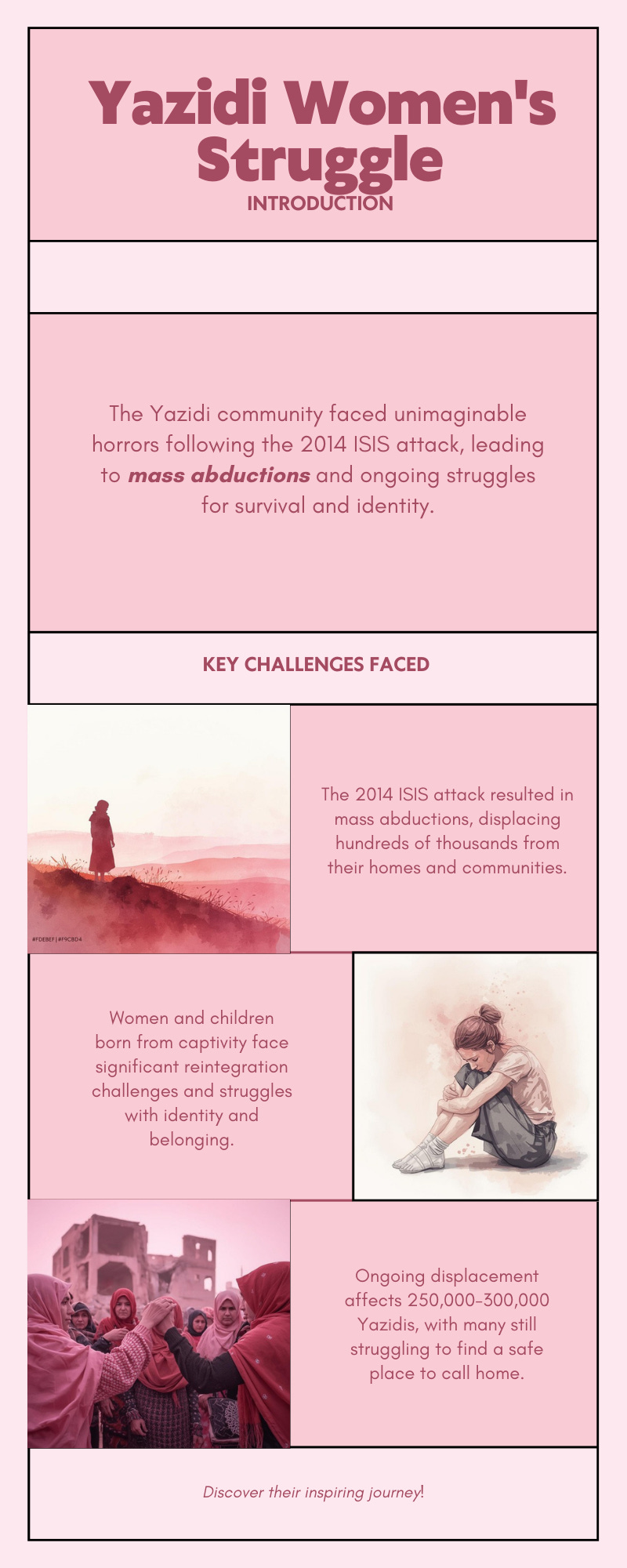
In August 2014, ISIS stormed northern Iraq and launched a coordinated attack on the Yazidi community in Sinjar. Thousands were killed and more than 6,000 women and children were abducted. Entire villages disappeared within days. The United Nations later recognised the assault as genocide. Five years later, in March 2019, ISIS lost its final territorial hold and the self-declared caliphate collapsed. For much of the world, this marked the end of a chapter. Headlines moved on.
For the Yazidis, however, the story did not end there. Nearly a decade later, between 250,000 and 300,000 Yazidis remain in displacement camps across northern Iraq. Sinjar is still politically unstable and economically fragile. The war may have ended militarily, but the struggle over identity, justice, and belonging continues in everyday life.
Explore this story with AI by using this prompt —
How does genocide reshape identity, and can a community survive if it must decide who is still allowed to belong?
The fall of ISIS removed the immediate existential threat. Families are no longer fleeing mountaintops and large-scale massacres have not returned. Yet stability in Sinjar remains uncertain. The 2020 Sinjar Agreement between the Iraqi federal government and the Kurdistan Regional Government was designed to unify security control and rebuild governance. In practice, progress has been uneven. Militias remain present, administrative authority is contested, and reconstruction projects move slowly. Electricity and water services function inconsistently in some districts. Many Yazidis hesitate to return without firm guarantees of long-term security and employment. Physical safety has improved, but political and economic stability still feel fragile.
To understand why rebuilding remains so complicated, you need to understand Yazidi identity itself. The Yazidis are an ancient ethno-religious minority with deep historical roots in Sinjar. Yazidism does not allow conversion. One is born into the faith, and belonging is inherited through lineage. Tribal affiliations and hereditary religious castes shape marriage, ritual participation, and community life. For centuries, these boundaries protected the Yazidis during repeated waves of persecution, including forced displacement under Saddam Hussein. Identity was never only cultural. It was a strategy for survival.
The genocide of 2014 fractured that protective structure. When women escaped ISIS captivity and returned home, the community faced a defining moment. In a landmark decision, Yazidi religious leaders publicly welcomed these women back into the faith. In many societies, survivors of sexual violence are blamed or excluded. That did not happen here. The decision signalled that what had been done to these women did not redefine who they were. Recognition, the basic human need to be seen and accepted, was restored in principle.
Explore this story with AI by using this prompt —
Why is legal recognition of genocide not enough for survivors?
Explore the gap between justice, implementation, and lived reality.
Yet reintegration also revealed a deeper tension. Some women returned with children born during captivity. Under traditional Yazidi religious law, belonging is determined by inherited lineage, and conversion is not recognised. This created a painful question that remains unresolved: can children fathered by ISIS fighters be considered Yazidi?
For many tribal and religious authorities, the answer remains no.
Supporters of this position frame it as preservation. Before 2014, the global Yazidi population was estimated at around half a million. Thousands were killed and many migrated permanently to Europe. After genocide, fears of demographic extinction intensify. Reinforcing lineage rules can feel like safeguarding survival. However, protection can clash with belonging.
For mothers raising these children, the debate is not abstract. It shapes daily life, from access to education and participation in religious ceremonies to social acceptance and future marriage prospects. Some women remain in displacement camps rather than return to villages where their children’s identity may be questioned. Others have migrated abroad, particularly to Germany, which now hosts the largest Yazidi diaspora outside Iraq. Tens of thousands have resettled there since 2014. Migration offers safety and opportunity, but it also transforms Sinjar’s future. Entire neighbourhoods remain underpopulated, and youth emigration slows economic recovery. Two decades from now, the social structure of Sinjar may look very different from what it once was.
The consequences of genocide are not only demographic. They are psychological. Studies estimate that between 70 and 90 percent of Yazidis suffer from post-traumatic stress disorder. More than 90 percent of women who endured captivity experienced multiple forms of violence. Mental health professionals describe widespread depression, chronic anxiety, and survivor’s guilt. Suicide rates have risen in some communities. Trauma continues to shape parenting, relationships, and trust within the community.
At the same time, rebuilding is taking place. Women’s centres in displacement camps now serve as safe spaces for counselling, education, and vocational training. These centres do more than provide therapy. They rebuild confidence and restore connection. Research shows that empowerment through earning income, gaining education, and rebuilding social networks significantly reduces symptoms of PTSD and depression. When women open small businesses, complete literacy programmes, or mentor younger girls, recovery becomes visible. Survival gradually turns into agency, even if the process remains uneven.
Economic rebuilding, however, remains fragile. Agriculture, once central to Sinjar’s economy, was disrupted during ISIS occupation. Fields were destroyed or mined, and investment has been limited. Youth unemployment remains high. Camps originally intended to be temporary have become semi-permanent communities. Children who fled Sinjar in 2014 are now entering adulthood after spending formative years in displacement. Education has resumed in many areas, yet interruptions carry long-term consequences for economic mobility and stability.
Justice has become another crucial dimension of recovery. In 2021, Iraq passed the Yazidi Survivors’ Law, promising financial compensation and formal recognition for survivors of ISIS atrocities. The law represented an important institutional acknowledgment. However, implementation has been slow. Survivors often face bureaucratic obstacles when applying for compensation. Recognition exists legally, but delivery remains inconsistent.
Explore this story with AI by using this prompt —
How do Yazidi women challenge the global narrative of victimhood after genocide? Explore their roles as survivors
International accountability efforts continue alongside domestic processes. Several European courts have prosecuted ISIS members for genocide and crimes against humanity. In contrast, many Iraqi trials focus primarily on terrorism charges rather than genocide classifications. The distinction is significant. Terrorism charges punish acts. Genocide charges acknowledge the intent to destroy a people. For survivors, naming the crime accurately is part of restoring dignity and affirming identity.
Nadia Murad, Nobel Peace Prize Laureate and Yazidi survivor, has played a central role in this global pursuit of justice. In conversation with the Cambridge Journal of Law, Politics, and Art, Murad emphasised that justice must extend beyond compensation. “We want accountability,” she said. For her, testimony itself is a form of justice, a way to preserve truth and confront denial. She has criticised the gap between international recognition and domestic enforcement, arguing that survivors deserve full legal acknowledgment of genocide. In this sense, justice is not only about punishment. It is about voice and about being heard.
Media coverage often freezes Yazidi women in the moment of violence. Research analysing UK newspapers found that they were frequently portrayed primarily as passive victims. That narrative overlooks the present. Today, Yazidi women are activists, educators, community organisers, and legal advocates. They speak at global forums, negotiate internal debates about identity, and lead grassroots initiatives in Sinjar and abroad. They are not only survivors. They are active participants in rebuilding their community.
Governance challenges continue to complicate progress. Political fragmentation between Baghdad and Kurdish authorities slows reconstruction. Armed groups retain influence in certain districts. Without unified governance, investment remains cautious and infrastructure rebuilding remains incomplete. Electricity, healthcare, and water systems operate inconsistently. Stability exists, but it remains delicate.
Explore this story with AI by using this prompt —
How does global media coverage shape public understanding of genocide and post-conflict communities
The Yazidi community now finds itself between two conflicts. The first was external and violently imposed by ISIS. The second is internal and structural, centred on identity and belonging. Protection seeks to preserve religious continuity that ensured survival for centuries. Adaptation acknowledges the realities shaped by genocide and displacement. Both impulses reflect the same instinct: endurance.
The deeper question facing Sinjar is not whether ISIS will return tomorrow. It is whether the community can rebuild the full spectrum of human needs, including safety, dignity, justice, participation, and belonging. Infrastructure can be reconstructed within years. Debates over identity may last generations.
The war ended in 2019, but the negotiation over belonging continues. Between preservation and change, Yazidi women remain at the centre of that negotiation. They are rebuilding homes, demanding accountability, supporting one another through trauma, and shaping the future of their community. Survival ensured continuity. The next few years will determine what that continuity becomes.
Accessed sources:
Ali, M.H. (2022). The Forced Displacement of Ethnic and Religious Minorities in Disputed Areas in Iraq: A Case Study of the Post-2014 Yazidi Minority. AlMuntaqa, [online] 5(1), pp.76–89. Available at: https://www.jstor.org/stable/48677172.
Hesford, W.S., Licona, A.C. and Teston, C. (2018). Precarious Rhetorics. [online] Ohio State University Press. doi:https://doi.org/10.2307/j.ctv1wsgqjn.
Lobanov-Rostovsky, S. and Kiss, L. (2022). The mental health and well-being of internally displaced female Yazidis in the Kurdistan Region of Iraq: a realist review of psychosocial interventions and the impact of COVID-19. Global Mental Health, 9, pp.508–520. doi:https://doi.org/10.1017/gmh.2022.55.
Nicolaus, P. and Yuce, S. (2017). SexSlavery: One Aspect of the Yezidi Genocide. Iran & the Caucasus, [online] 21(2), pp.196–229. doi:https://doi.org/10.2307/44631115.
Nicolaus, P. and Yuce, S. (2019). A Look at the Yezidi Journey to Selfdiscovery and Ethnic Identity. Iran & the Caucasus, [online] 23(1), pp.87–104. doi:https://doi.org/10.2307/26626714.
Sarac, B.N. (2020). UK Newspapers’ Portrayal of Yazidi Women’s Experiences of Violence under ISIS on JSTOR. Jstor.org, [online] 13. doi:https://doi.org/10.2307/26907413.
van Zoonen, D. and Wirya, K. (2017). Yazidism and its Community in Iraq. [online] JSTOR. Available at: https://www.jstor.org/stable/resrep13635.5.
Women for Women International (2024). A decade of transformation for Yazidi women but the Trauma continues | Women For Women. [online] Women for Women International. Available at: https://womenforwomen.org.uk/blog/yazidi-genocide-tenth-anniversary.
In this episode Diana discusses the post conflict experience of Yazidi Women and their issues with re integrating into society. She is a Citizen journalist with us on a placement organised with Department of War Studies, King’s College, London.
Thank you for reading an A4R 🎨 Post. Don’t forget to try out gaming art NFT’s here. Every purchase scales our impact and pays our bills.


