


Post-Conflict Pop Culture: A look into how Youth-Cultural Diplomacy is shaping the international view of Kosovo and building bridges in the Balkan region
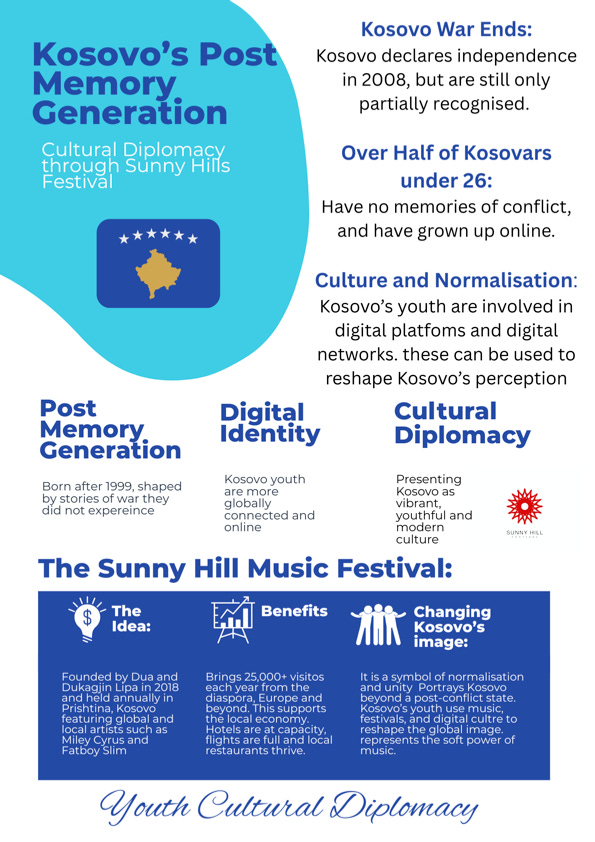
On the 1st August 2025 in Prishtina, Kosovo, Dua Lipa stepped out on stage at the Sunny Hill Festival. Greeted with a roaring reception, this was not her first appearance; it was her idea in the first place.
Alongside her father, Dukagjin Lipa, a native Kosovar who moved to London in the 1990s following the war in the region, Dua launched the festival 2018 with the aim of bringing together not only Kosovars, but the wider Balkans and diaspora. Featuring performances from local artists to international names such as Miley Cyrus and Fatboy Slim, Sunny Hill has helped unite audiences through music while projecting Kosovo as more than just a post-conflict society.
The Balkans has long been a contested region of southeastern Europe. Once part of the Ottoman and Austro-Hungarian Empires, and later incorporated into socialist Yugoslavia, it has been shaped by overlapping identities and territorial tensions. The violent breakup of Yugoslavia in the 1990s exposed these fractures, producing wars in Croatia, Bosnia and ultimately Kosovo.
Landlocked between Serbia, Albania, North Macedonia and Montenegro, Kosovo holds deep historical significance for Serbia, particularly through the symbolism of the 1389 Battle of Kosovo. By the late twentieth century, however, Kosovo had become overwhelmingly ethnically Albanian. In 1989, Serbian leader Slobodan Milošević revoked Kosovo’s constitutional autonomy, placing it under direct rule from Belgrade and marginalising Kosovo Albanians from public life.
By the late 1990s, an armed resistance known as the Kosovo Liberation Army was in heavy conflict with a harsh Serbian counterinsurgency. The conflict led to mass displacement and more than 13,000 deaths or disappearances between 1998 and 2000. Amid fears of ethnic cleansing, NATO launched a 78-day air campaign in 1999, forcing Serbian withdrawal.
Kosovo declared independence in 2008 but remains unrecognised by Serbia, as well as by Russia, China and five EU member states. This partial recognition has prevented membership in the United Nations and the European Union. Tensions persist, particularly in the divided city of Mitrovica, where ethnic separation remains visible. Economic strain, emigration and political fragmentation continue to shape the state’s trajectory. Yet this diplomatic stalemate does not fully capture the direction in which Kosovo’s society is moving.
Youth-led cultural initiatives suggest a different dynamic. Artists such as Rita Ora and Dua Lipa have amplified Kosovo’s global visibility. More significantly, they have reframed it. Non-state actors and digital networks have begun to influence perception in ways that formal diplomacy has struggled to achieve.
This new generation of cultural ambassadors born directly after the conflict, are often described as the Post-Memory Generation. They were raised on stories of the war, in households shaped by trauma, but they themselves have no lived memory of it. Today, anyone under twenty-six in Kosovo was born after 1999, and anyone under thirty likely has no personal recollection of the violence. Having the youngest population in Europe, with approximately fifty-three per cent of the population under twenty-five, over half the country has no direct memory of the conflict.
Rather than lived trauma, many carry transmitted trauma. Research suggests that children of parents suffering from war-induced PTSD are more likely to experience intergenerational psychological effects. Through family narratives, school curriculums and memorial days, the past remains the present, even for those that did not experience it.
This distinction matters. Identity formed through direct trauma tends to be anchored in survival and loss. Identity formed after trauma has other influences. Kosovo’s post-war generation has grown up not only with recent history of loss, displacement and anger, but also with the internet, a large diaspora network and a much more global culture surrounding them. The youth of Kosovo today may be the first post- conflict generation to grow up almost entirely online, and this gives them a unique opportunity. It could be possible that the digital environment is able to dilute inherited grievance. While war remains a strong part of the national narrative, it competes with other networks: global music scenes, friendships across borders, diaspora networks and a shared European youth culture. Identity is no longer constructed solely through memory but also through digital participation and global pop cultures.
This shift has consequences beyond the individual. A generation that does not define itself through victimhood is more likely to project confidence, modernisation and a push forward. Rather than arguing for recognition through the language of grievance, they signal normalcy through what they build, organise and create, and a willingness to move beyond history. In this sense, Kosovo’s post-memory generation is emerging as a form of informal cultural diplomacy. Through festivals, art, music and digital platforms, they present Kosovo not as a frozen conflict but as a functioning, creative, contemporary society.
Nowhere is this more visible than at the Sunny Hill Festival. What appears on the surface to be a music event is also a performance of national self-definition. Lipa and her father have brought international artists, diaspora communities and local youth into a shared space that feels global. It has no focus on politics, international or domestic, instead, it presents Kosovo as connected and youthful. For a generation born after the war, this is not an attempt to live in history, it is an effort to live beyond it. Ultimately, Sunny Hills acts as an influence beyond the state.
Each summer, the festival draws thousands of visitors from across Europe and the Kosovar diaspora. Flights into Prishtina are full, hotels are at capacity, the city comes alive and the economy booms. For members of the diaspora, Sunny Hill offers a chance to immerse in cultural heritage, and for international visitors, it is often a first encounter with Kosovo. This encounter is seen not through conflict reporting, but through music, crowds and a bustling capital city.
In a state still navigating partial international recognition, that visibility matters. Formal diplomacy remains slow and constrained by geopolitics. Cultural gatherings operate differently. Artists speak about performing in Kosovo, visitors share images online, and alternative narratives circulate without being framed as political argument. The country appears less as a frozen dispute and more as a functioning society. This does not resolve structural tensions, nor does it replace political dialogue. But it subtly shifts perception.
Sunny Hill therefore operates beyond the state. It brings international artists, regional audiences and diaspora communities into the same physical space, creating familiarity where distance once defined the relationship. In doing so, it expands how Kosovo is seen, both abroad and at home. For a generation born after the war, this is less about rewriting the past than about establishing a different baseline for the future. Recognition, in this context, is not demanded. It is normalised.
Peace has held in Kosovo for over two decades, but normalisation is still unfolding. While questions regarding sovereignty and recognition remain subjects of formal diplomatic negotiation, a quieter transformation is taking place outside of these negotiations. On stages, in cultural spaces and across digital networks, a generation without a lived memory of war is now reshaping how Kosovo is seen. This shift is not loud, and it is not official, but it is having an impact just as powerful.
Bibliography
Goff, Patrica, “Cultural Diplomacy,” in Nancy Snow, Nicholas Cull (eds.), Routledge Handbook of Public Diplomacy (New York, 2020), 30-37.
Nitaj, Laberion, “Art Festivals: A Bridge Between Serbia and Kosovo”, New Social Initiative, (August 2024), https://newsocialinitiative.org/wp-content/uploads/2024/10/Policy-Paper-Laberion-Nitaj.pdf, accessed 13 February 2026.
Rosney, Daniel, “Sunny Hill: Dua Lipa’s Family Festival ‘Changing’ Kosovo’s Image”, BBC News, (30 July 2024), https://www.bbc.co.uk/news/articles/c72v40pmgv1o, accessed 13 February 2026.
Sassi, Lorenzo and Amighetti, Emanuele, “Kosovo: A young country, being shaped by its youth”, Politico, (2018), https://www.politico.eu/interactive/in-pictures-kosovo-10th-anniversary-future-being-shaped-by-its-youth/, accessed 13 February 2026.
See the Kosovo Memory book at: https://www.hlc-rdc.org/en/loss-database/kosovo-memory-book/
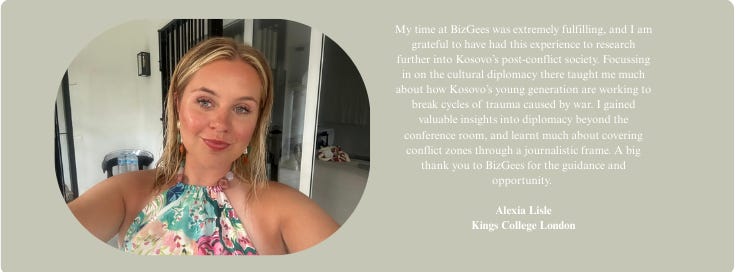
In this episode Alexia discusses the post conflict experience of Kosovo and how today’s youth are are taking ownership of their country using festivals and the arts to rebuild their nation. She is a Citizen journalist with us on a placement organised with Department of War Studies, King’s College, London.
Thank you for reading an A4R 🎨 Post. Don’t forget to try out gaming art NFT’s here. Every purchase scales our impact and pays our bills.


