


From Rainbow Nation to Unfinished Freedom: Postmemory and the Search for Justice in South Africa
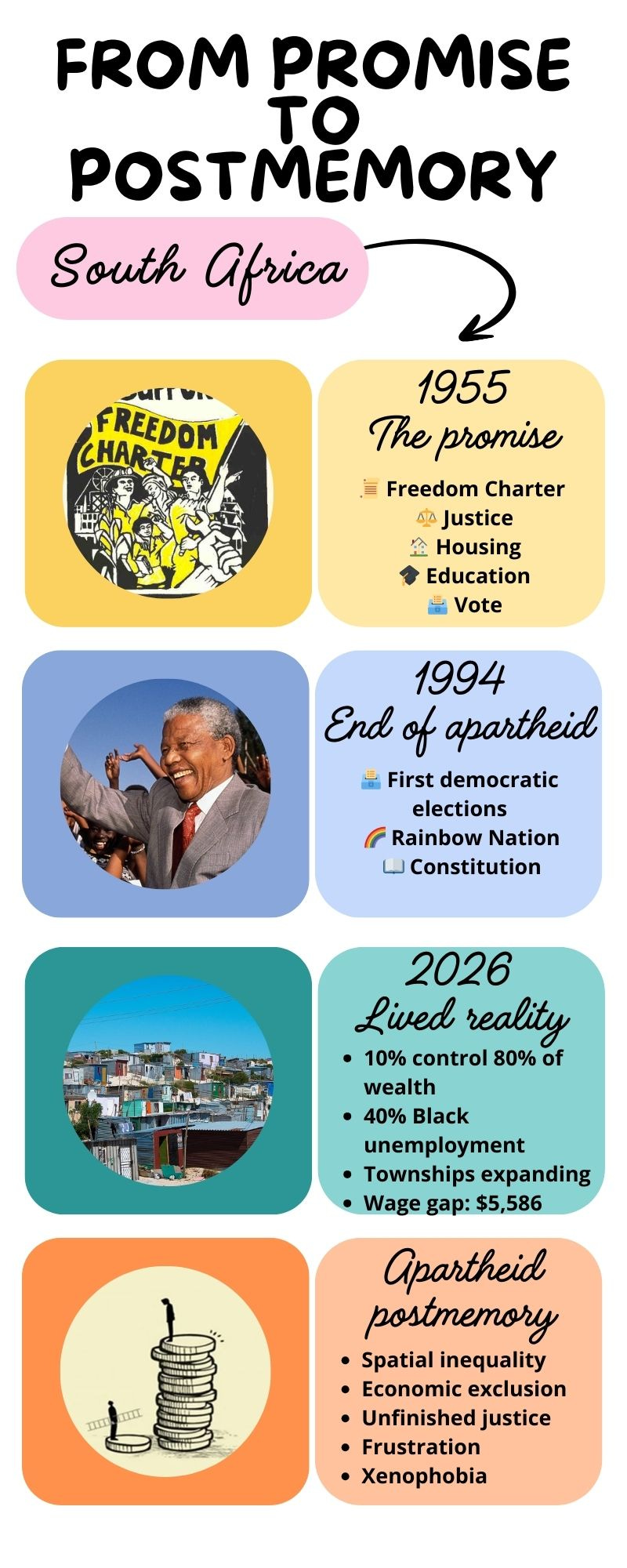
More than 30 years after apartheid’s legal end, South Africa remains one of the least equal countries in the world. The country once referred to as the “Rainbow Nation” is today a vivid reminder of apartheid through spatial and economic legacies: under-resourced townships, stark education and employment differences, and concentrated wealth. For the second and third generations of black South Africans, apartheid survives not only as testimony but as inherited spatial arrangements and inequality that continue to shape their everyday lives. That inheritance turns formal freedom into a symbolic condition and renders the Freedom Charter’s promise of redistribution, autonomy, and freedom an unresolved demand.
Context
In 1994, South Africa held its first democratic elections, resulting in the African National Congress (ANC), led by Nelson Mandela, emerging victorious (Gumbi et al., 2024). This event marked the end of apartheid (Afrikaans for “separateness”), a racial segregation system established in 1948 by the Dutch settlers’ National Party (NP). During apartheid, black people were forced to live separately from white people, denied access to many jobs, and discriminated against in wages and rights (such as voting), leading to widespread poverty. When the ANC came to power, this system was legally dismantled, and Archbishop Desmond Tutu famously coined the country as the “Rainbow Nation”: an ethnically and culturally diverse, equal, fair, and cooperative South Africa (Nelson Mandela Foundation, 2024).
However, present-day South Africa is far from being a “Rainbow Nation”. Although all South Africans are now legally free and equal, the legacy of apartheid still affects the economy and spatial distribution. This makes South Africa one of the least equal countries in the world, with 10% of the population controlling 80% of the wealth (Lawal, 2024). The economy grew after apartheid, but, since then, only a small portion of the GDP reaches black households (Lawal, 2024). Furthermore, gross debt reached 71.1% of the GDP in 2022 due to corruption and government inefficiency (Lawal, 2024). This has resulted in the absence of a middle class, highly unequal land ownership, and a wage difference between white and black households of $5,586 per month (Lawal, 2024). In early 2023, black unemployment was around 40%, while only 7.5% of the white population was unemployed (Lawal, 2024).
In addition, public schools lack resources and face persistent racism, while limited transport access makes it difficult for low-income families living in remote areas to reach former white schools, which continue to offer better facilities and resources (Lawal, 2024). Likewise, black students are still underrepresented in higher education (Lawal, 2024).
Another facet of apartheid’s legacy is housing. While there’s been a redistribution of population across the country, allowing black South Africans to move closer to city centres and business districts, rural and poorly equipped townships, where black populations were relocated to during apartheid, still exist. These townships, which remain racially segregated and are continuously growing, are separated by buffers from predominantly white, high-income neighbourhoods (Lawal, 2024). Government funds providing homes for low-income families contribute to this spatial inequality, as such houses are far from economic centres, with poor transport networks, making rural unemployment twice as high as in other parts of the country (Lawal, 2024).
The Freedom Charter and Human Needs
The persistence of structural inequalities contrasts sharply with the aspirations that once defined the anti-apartheid movement: the Freedom Charter of 1955. This document was adopted by the Congress Alliance, a coalition between the ANC and other liberation movements. It called for equal rights, democratic participation, economic redistribution, freedom to choose where to live, free and equal education, and the end of racial segregation (African National Congress, 1955). Although formal dismantling of apartheid occurred, the transformative vision outlined by the Charter remains distant in today’s South Africa.
To unpack this vision, we must trace three interlocking human needs at the heart of the Freedom Charter’s anti-apartheid struggle: social justice as the demand for economic redistribution and equal life chances; freedom understood not merely as legal rights but as the real capacity to shape one’s life; and autonomy as the capacity to live and work within dignified space. First, social justice questions whether legal change transformed into material equality or whether existing wealth patterns persisted. While the Freedom Charter promised a radical wealth transfer, the post-apartheid transition involved an elite pact between corporate capital and the ANC, leading to the adoption of neoliberal policies rather than a wealth redistribution to meet human needs (Gibson, 2012). As a result, these policies have led to the so-called Black Economic Empowerment (BEE) which has created a new elite of “black diamonds” whose wealth is entrenched in the dynamics of capitalism and quick profit rather than national accumulation (Gibson, 2012).
Second, while justice addresses redistribution, freedom highlights the gap between legal equality and material conditions, the latter essential to truly experience equality under the law. Although apartheid has been legally dismantled, the economic realities outlined above – 10% of the population controlling 80% of the wealth, massive black unemployment, and the continued relocation of poor black communities to peripheral townships – demonstrate that formal freedom doesn’t translate into substantive freedom, equal opportunities, or lived equality. Third, autonomy focuses on the spatial and economic barriers preventing people from controlling their own lives. Due to neoliberalist policies, a large proportion of black South Africans are forced to relocate to expanding state-funded townships outside economic centres and big cities. These cities, therefore, have been “deracialized” through a “bourgeois” phenomenon, as access to them is granted by money (Gibson, 2012). Spatial segregation thus continues in the post-apartheid era, showing how Fanon’s argument that colonial domination is inscribed in the “ordering and geographical layout” of societies remains true in a postcolonial society (Gibson, 2012). As black populations are relocated in these poor townships, they lose autonomy to live, move, and work with dignity, limiting their actual choices.
Apartheid Postmemory
Economic and spatial inequality become in this way a material form of postmemory. New generations inherit not the apartheid itself, but the urban structures and poverty through which its divisions continue. In this case, postmemory does not only take the form of indirect stories on the periphery of new generations’ consciousness but also acquires a real and vivid form through which second and third generations experience those stories first-hand.
The memory of the “Promised Land” – the vision articulated by the ANC and embodied in the Freedom Charter – also becomes central to apartheid postmemory. For new generations, freedom is not just a lived struggle, but an inherited narrative of hope: a promise of an equal and just country, where everyone has access to the same opportunities regardless of skin colour. Yet the persistence of economic exclusion, government corruption, and spatial inequality have turned this hope into disillusionment and anger. In this sense, postmemory operates not only through inherited trauma but through inherited expectation of justice that remains unfulfilled.
Nigel Gibson (2012) argues from a Fanonian perspective that the post-apartheid transition did not transform South Africa’s economic structure, resulting in an “incomplete liberation.” The degeneration of the “Promised Land” manifests itself in rising frustration among the poor, who experience freedom as symbolic (end of apartheid and political rights) rather than substantive (material transformation). The symptom of this frustration – xenophobia – has been directed towards “black foreigners” rather than political leaders or economic elites, as seen in the 2008 riots, targeting poor African migrants, while white foreigners – viewed as investors or tourists – have remained untouched (Gibson, 2012).
Nearly three decades after Desmond Tutu coined the term “Rainbow Nation,” the ideal remains aspirational. The ANC faces accusations of self-enrichment and of failing to deliver on material justice (BBC, 2024). While South Africa boasts linguistic and skin colour diversity and progressive rights, persistent inequality and racism contrast with the promise of equality, unity, and justice (Nelson Mandela Foundation, 2024).
Thus, in contemporary South Africa, apartheid postmemory isn’t confined to past suffering stories. It’s embedded in inherited spatial divisions, economic exclusion, and the expectation of justice yet to come. The born-free generation doesn’t experience apartheid directly, but inherits its spatial, economic, and affective legacies.
Bibliography
African National Congress. (1955). The Freedom Charter Congress of the People, Kliptown. https://www.anc1912.org.za/the-freedom-charter-2/
BBC. (2024). Thirty years since apartheid ended: What was it, how did it end, and why did it start? Retrieved 10/02/2026 from https://www.bbc.co.uk/newsround/68937527
Gibson, N. C. (2012). What Happened to the “Promised Land”? A Fanonian Perspective on Post-Apartheid South Africa. Antipode, 44(1), 51-73. https://doi.org/10.1111/j.1467-8330.2010.00837.x
Gumbi, K., Kumwenda-Mtambo, O., Kongkunakornkul, P., Sen, S., & Sachdev, V. (2024). Thirty years after the end of apartheid, equality eludes South Africa. Reuters. Retrieved 10/02/2026 from https://www.reuters.com/graphics/SAFRICA-ELECTION/ECONOMY/egpbonzrgvq/
Lawal, S. (2024). South Africa: 30 years after apartheid, what has changed? Al Jazeera. Retrieved 10/02/2026 from https://www.aljazeera.com/news/2024/4/27/south-africa-30-years-after-apartheid-what-has-changed
Nelson Mandela Foundation. (2024). The Rainbow Nation ideal: an ever-distant promise. Retrieved 10/02/2026 from https://www.nelsonmandela.org/news/entry/the-rainbow-nation-ideal-an-ever-distant-promise
In this episode Laura discusses the post apartheid experience of South Africa. What the situation on the ground is decades down the road. She is a Citizen journalist with us on a placement organised with Department of War Studies, King’s College, London.
Thank you for reading an A4R 🎨 Post. Don’t forget to try out gaming art NFT’s here. Every purchase scales our impact and pays our bills.


