


Shared Threads: Gendered Violence and Collective Reconstruction in Post-Genocide Rwanda
In a workshop in Kayonza, eastern Rwanda, the steady rhythm of sewing machines fills the room. Women sit closely together, measuring fabric, guiding thread through cloth, and pausing occasionally to speak to one another. The work is careful and continuous. For the members of the Abasangiye Cooperative, this shared space is not simply a place of production, but part of a longer process of rebuilding in the aftermath of the Rwandan Genocide.
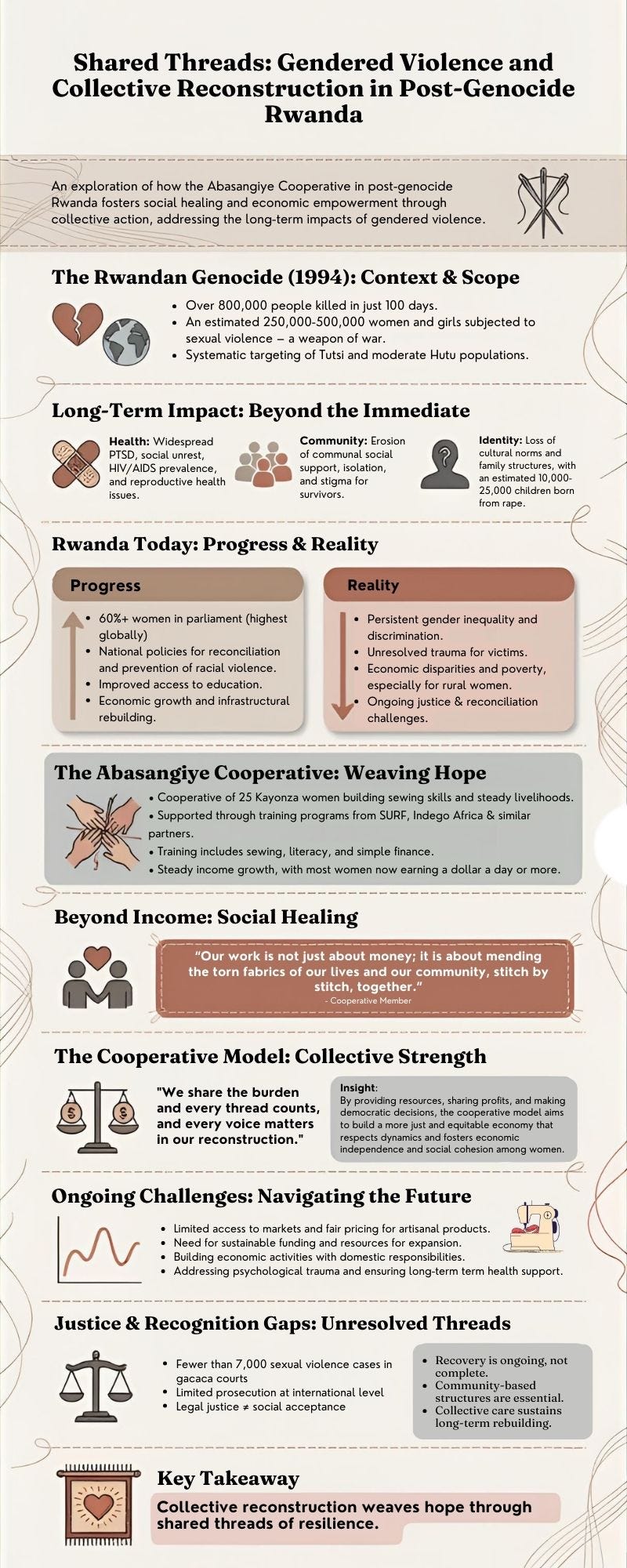
The Rwandan genocide, in which an estimated 800,000 to one million people were killed in approximately 100 days, was marked by the widespread and organised use of sexual violence. Between 250,000 and 500,000 women and girls are believed to have been subjected to rape, often perpetrated by militia groups, soldiers, and civilians, frequently within their own communities.
This violence was not incidental. It formed part of a broader strategy to terrorise, displace, and dismantle social structures. An estimated 10,000 to 25,000 children were born as a result, and many women have since lived with chronic health conditions, including HIV. Survivors and their children frequently navigate stigma and exclusion, even as they build relationships and communities that reflect resilience and care.
Rwanda is often presented as a model of post-conflict recovery: economic growth has been sustained, infrastructure expanded, and women now hold over 60 percent of parliamentary seats—the highest proportion globally. Yet these national indicators only partially capture the realities of recovery. Experiences remain uneven, particularly in rural areas, where economic opportunity is limited and many women rely on informal or cooperative-based work.
For survivors of the gendered violence of 1994, recovery is an ongoing condition, shaped by long-term health needs, access to resources, and social attitudes that do not always evolve in step with state-led narratives of reconciliation. In this context, reconstruction has often taken place not through institutions alone, but through small, collective structures embedded in everyday life. The Abasangiye Cooperative, a sewing and artisan group of 25 women in Kayonza, emerged within this context. Supported by organisations including Survivors Fund (SURF) and Indego Africa, the cooperative brings together victims of the genocide’s sexual violence, many of whom had previously been part of the widows’ association AVEGA Agahozo.
At its inception, the women who would form the Abasangiye Cooperative had little access to formal employment, financial services, or vocational training. What began as a small training group of 25 women learning textile and artisan skills has since developed into a space where economic participation and personal recovery are closely intertwined. Through the cooperative, members have gained skills not only in sewing, but also in literacy and financial management, enabling them to engage with both local and international markets. Programme data reflects this shift: the proportion of women earning at least one US dollar per day rose from 7 percent in 2008 to 67 percent in 2011.
Yet these figures only partially capture what the cooperative represents. Members often describe an immediate recognition in one another; a shared understanding that does not require explanation. As one member explained, “We all come from different villages and everyone has their own individual problems and lived in isolation, but when we met in this group we talked about our problems and shared our problems, which makes us feel relieved”. Within this space, experiences shaped by violence can be acknowledged and support becomes embedded in the rhythms of daily work.
In rural contexts where formal mental health provision remains limited, such networks take on additional significance. Care circulates informally —the act of gathering, of speaking and of being heard— woven alongside the production of textile goods. What emerges is not only a source of livelihood, but a community for healing.
Abasangiye’s spirit to income distribution is of similar vein; rather than linking earnings to individual output, the cooperative shares income equally among members. This model reflects the realities of its participants. Some women can work consistently, while others face periods of illness or reduced physical capacity. As one member explained:
“Some are sick with HIV or have trauma or body weaknesses, while others are strong...we share equally despite ability.”
Equal distribution ensures that all members remain included, regardless of fluctuations in their ability to produce. Such an approach challenges conventional economic assumptions about productivity and value. Instead, it reflects a system shaped by interdependence, where stability is prioritised over individual output.
Despite these structures, financial stability remains uncertain. Income from handicraft production is tied to fluctuating market demand, with monthly earnings ranging between 20,000 and 50,000 Rwandan francs (approximately $15-$40 USD). Such variation makes it difficult to plan for essential costs, and even short gaps in orders can place immediate strain on households already operating within narrow margins. This instability is not unique to Abasangiye. Studies of similar cooperatives in Rwanda point to a broader pattern: while participation can improve earnings over time, it does not fundamentally resolve the structural conditions of poverty or reliance on informal labour.
The cooperative also sits within the unresolved social dimensions of post-genocide justice. International prosecutions, including those conducted by the International Criminal Tribunal for Rwanda (ICTR), initially faced significant challenges in addressing sexual violence. Although the ICTR ultimately issued landmark judgments recognising rape as a constitutive act of genocide, such cases formed a relatively small proportion of its overall docket and were often constrained by evidentiary and procedural limitations.
Alongside international efforts, Rwanda introduced extensive domestic mechanisms, most notably the community-based Gacaca courts, which operated from 2002 to 2012. While these courts handled a vast number of genocide-related cases, sexual violence was frequently underreported and, in many instances, addressed outside public proceedings. As a result, many survivors continue to navigate stigma and social exclusion even where formal legal processes have taken place. This gap points to a broader limitation of post-genocide justice: legal accountability does not automatically translate into social recognition, reintegration, or material security.
It is within this gap, between formal recovery and lived reality, that the significance of Abasangiye lies. The cooperative does not resolve the economic or social consequences of violence, nor does it claim to. Instead, it operates as a practical response to their persistence. Through shared labour, collective income, and embedded systems of support, it enables members to navigate conditions that remain uncertain.
The Abasangiye cooperative therefore reflects a form of reconstruction that is ongoing rather than complete. Its relevance extends beyond Rwanda: it points to the limits of state-led recovery models, and to the importance of community-based structures in sustaining life after conflict. What emerges is not a singular narrative of recovery, but a cumulative one; built through routine, interdependence, and the continued work of maintaining community in the present.
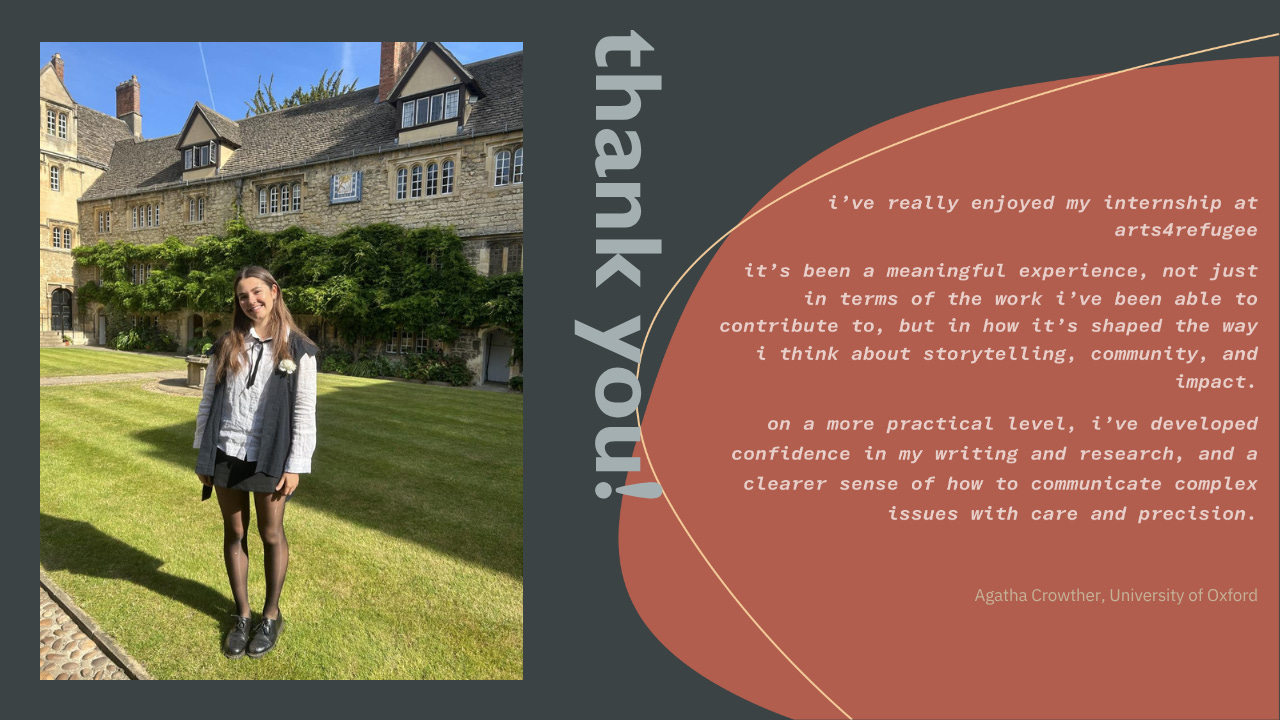
In this episode Agatha discusses the post conflict experience of Rwanda and the Abasangiye cooperative. It goes into the role the collective played in rebulding lives and communites post genecide. She is a Citizen journalist with us on a placement organised with Oxford University Career Services.
Thank you for reading an A4R 🎨 Post. Don’t forget to try out gaming art NFT’s here. Every purchase scales our impact and pays our bills.


