


Like most conflicts and wars in the world, what most people see are footages of fallen buildings, collapsed roads, and displaced civilians. However, the lasting chronic impacts of wars often happen once the cameras leave; when societies are left to themselves with broken infrastructure and collapsed systems. Yemen’s story is no different. What began as a civil war in 2015 has now left Yemen with a chronic conflict, broken infrastructure, and a constant fight for survival.
Backstory
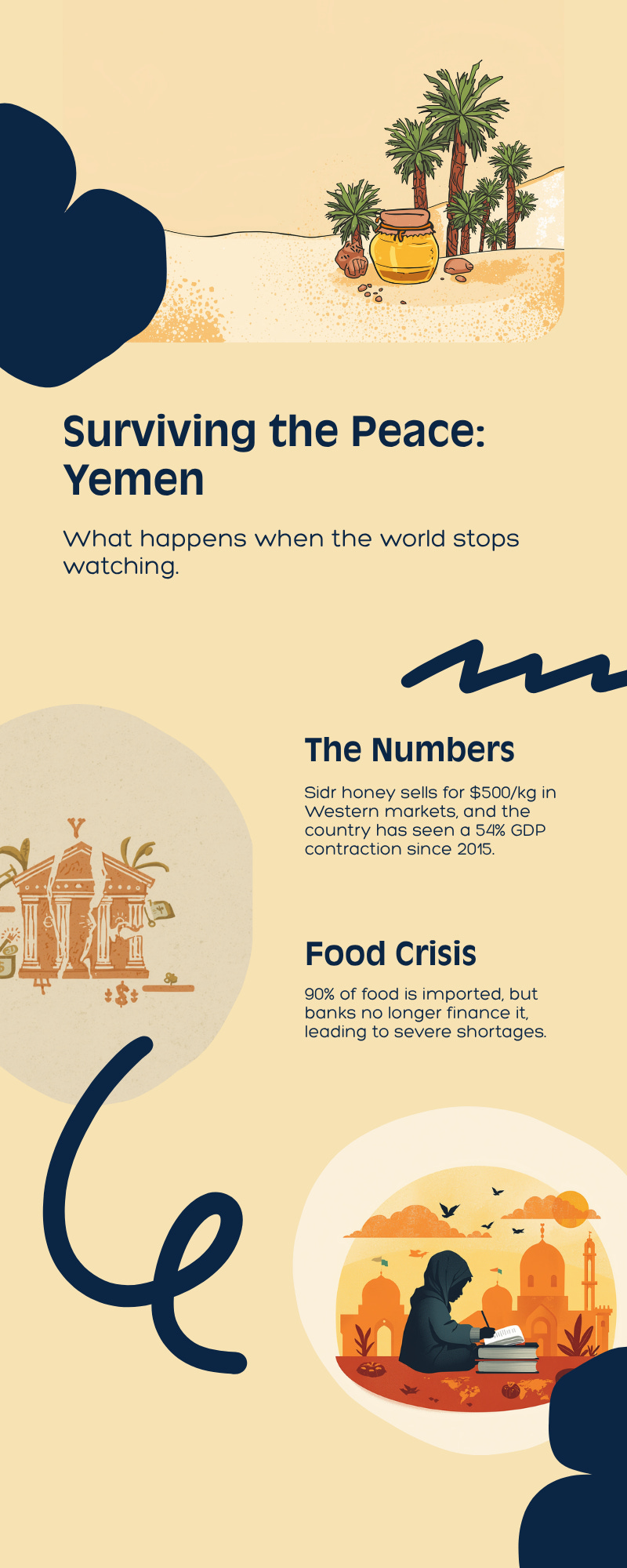
Before it’s too late!
When missiles stop firing and political leaders stop making statements about the kinetic conflicts and military strategic objectives, unfortunately, these conflicts stop making news on global headlines. This article tries to look at how Yemen has been surviving the impacts of the conflict which now seldom receives the footage on global news, but still very much struggles to survive.
One country, two economies, both failed.
After the Yemeni Internationally Recognised Government (IGR) relocated its operations from Sana’a to Aden, Yemen is split into two parallel economies. The split in the Central Bank of Yemen and consequent running of two parallel economies has had a strong impact on Yemen’s economy. The World Bank’s 2025 Yemen Economic Monitor reveals that the GDP is projected to decline by 1.5% in the financial year 2025-26 (World Bank Group, 2025). As of June 2025, the price of a basic food basket was 26 percent higher than a year earlier (ibid). As of September 2025, only 19 percent of the USD 2.5 billion required under the UN Humanitarian Response Plan for Yemen had been funded, marking the lowest level in over a decade (ibid). With limited donor support, high food prices, and shrinking job opportunities, more than 60 percent of households in both IRG- and Houthi-controlled areas report inadequate food consumption, with many resorting to negative coping mechanisms such as begging (ibid).
Before the conflict, Yemen imported up to 90% of its food. Commercial banks facilitated transactions for these crucial economic activities. These basic economic activities are no longer done by commercial banks. Informal and unregulated credit chains which not just extract value at every stage of business but also every basic transaction is the unfortunate reality, and evidence to the broken system that Yemen functions in.
Honey trade, which is one of the most pursued occupations in Yemen is severely affected by this. The markets and buyers for the Sidr honey, which is a premium commodity in European markets very much exist, but the structure to support the running of this business does not. The question, therefore, is not whether economic activity exists in Yemen. It is whether that activity is building anything or is it simply the sound of people running to stay in the same place.
What does the honey and the cooperative tell us
Hadhramaut produces between 30 to 40% of Yemen’s total honey output (Live Beekeeping, 2025). The Sidr honey that comes from here is one of the most premium commodities in European as well as Gulf markets.
The beekeepers who produce it have organised themselves into cooperatives. Not because cooperation is an ideology, but because it is a survival strategy. A Hadhramaut beekeeper individually has no negotiating power with a Gulf buyer. Collectively, they can set a floor price. They pool risk, that is, if one member’s supplies fail because of displacement or illness, the group absorbs it. They run informal credit chains between each other because formal credit does not exist. They sell through diaspora networks in Saudi Arabia and the UAE because the formal export infrastructure has collapsed. On the surface, it appears like an impressive success story in the middle of a war. It is rather a survival effort to survive a failed system. This ecosystem is fragile and the prospects of its sustainability are rather bleak.
Labour trauma
The people building Yemen’s economy are the same people who lived through its destruction. Participation in these cooperatives is uneven. Members support each other because everyone is facing displacement, illness care responsibilities and trauma. Economic participation here does not mean recovery; it is a daily fight for survival.
The disappearing floor
A significant portion of Yemen’s economic activity runs on humanitarian aid. This is not real market, and it is shrinking too, as discussed above. These cuts are landing on the communities that were trying to build on these aids.
The generation that is growing in the gap
Nearly half of Yemeni children under five suffer from stunting, a chronic malnutrition disease (UNICEF, 2024). In 2025, 3.7 million children aged 5 to 17 are out of school. Those still attending endure overcrowded classrooms with teachers who are overworked, unsupported, and unpaid since 2016 in the northern areas of Yemen. In addition, 94.7 per cent of 10-year-olds in Yemen are unable to read or understand a simple text, an issue called learning poverty (United Nations Yemen, 2025).
When the A4R talks about what happens 20 years down the road, this is what we are talking about. These children are already on the road.
What resilience looks like
The cooperative model looks like a silver line amidst all of this, to some extent it is, but its sustainability is fragile. Resilience in Yemen is not a triumph story, but an account of daily thrive for survival. The cooperative is trying to compensate for missing banks, missing roads, missing certification and documentation bodies- something that does not come in its ambit. The centuries long knowledge of beekeeping is still being passed on, but with diminished prospects of recovery.
Resilience in Yemen does not look like hope. It looks like a group of traders deciding, again, to show up, because the alternative is not showing up at all.
What comes next?
Tomorrow, the Hadhramaut beekeeper will reopen his stall. He will continue to sell his honey through unofficial routes that shouldn’t be necessary, at prices that should be higher, within a system that ought to function better. He has done this for years, so many, that most people outside Yemen have lost track. The central question this article cannot resolve, the one that underlies everything: how long a survival mechanism can stand in for the infrastructure needed for genuine recovery? How much longer until informal credit collapses? Until diaspora support dwindles? Until the generation who remembers pre-2015 Yemen disappears? Yemen does not need pity from the world; it needs enduring, informed, and honest attention. Not the fleeting concern of crisis headlines, but a sustained commitment to understanding what it means to survive without the systems that true survival demands. The honey remains excellent and the beekeeper knows this already. The real question is whether those responsible for rebuilding the systems around him will recognize this before it’s too late.
References
Live Beekeeping. (2025, October). Why Yemeni honey is expensive, how to choose it, and whether it is worth buying. Live Beekeeping. https://livebeekeeping.com/honey/yemeni-honey/
Pragma. (2020). Economic Recovery and Livelihoods Program (ERLP) – Pragma. Pragmacorp.com. https://pragmacorp.com/erlp/
UNICEF. (2024, March 26). 9 years into the conflict in Yemen, millions of children are malnourished and stunted. Www.unicef.org. https://www.unicef.org/press-releases/9-years-conflict-yemen-millions-children-are-malnourished-and-stunted
United Nations Yemen. (2025). UNICEF Yemen: Providing safe learning space for children in Yemen. Yemen. https://yemen.un.org/en/294567-unicef-yemen-providing-safe-learning-space-children-yemen
Wabar, M. B. (2024, January 8). Yemeni Honey Production: An Ancient Craft Drawing Modern Attention. The Washington Institute. https://www.washingtoninstitute.org/policy-analysis/yemeni-honey-production-ancient-craft-drawing-modern-attention
World Bank Group. (2025, November 18). Economic Hardship Deepens in Yemen. World Bank; World Bank Group. https://www.worldbank.org/en/news/press-release/2025/11/17/economic-hardship-deepens-in-yemen
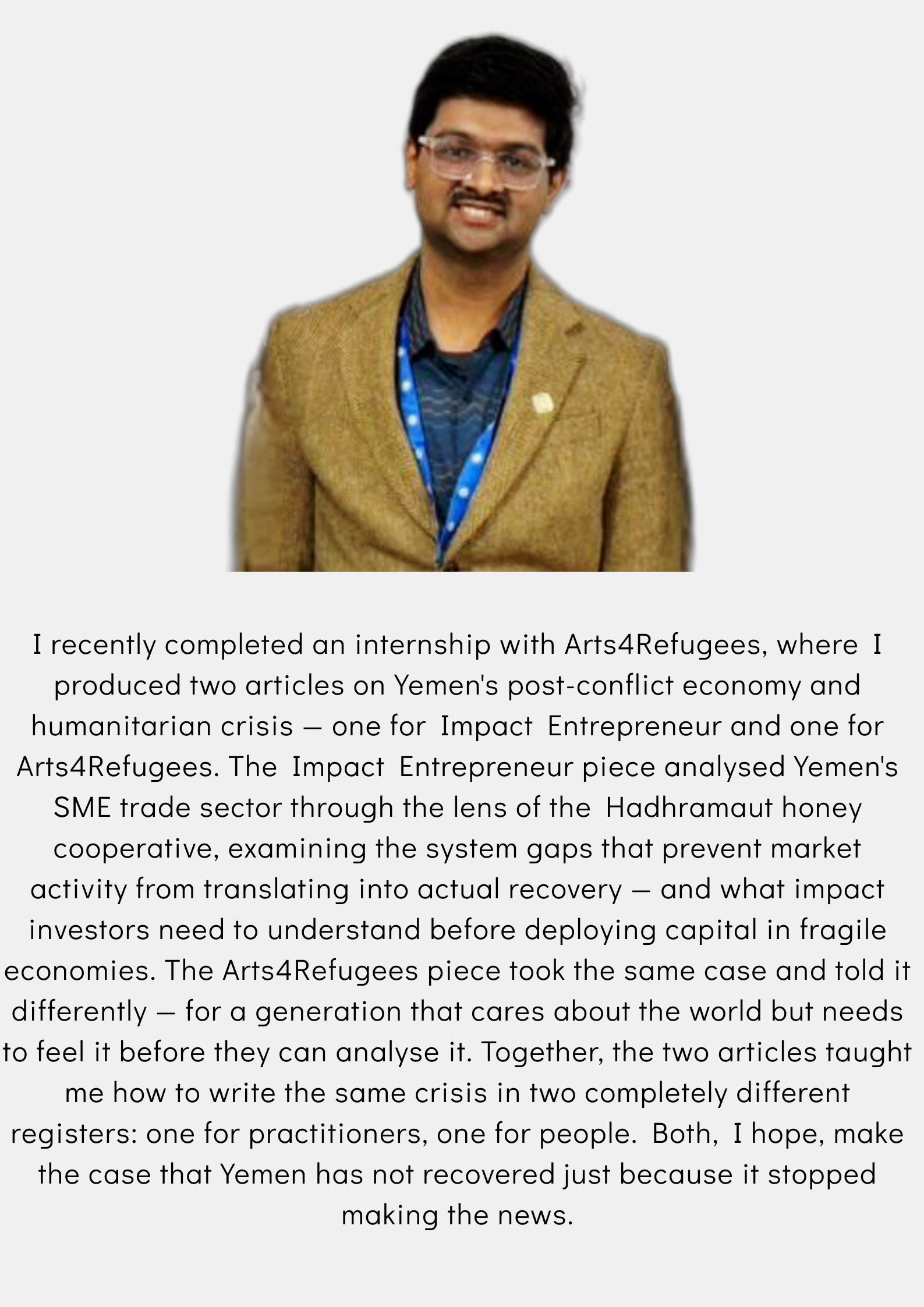
In this episode Sameeran discusses the expereince of Yemeni expereince of rebuolding their country and their lives. He is a Citizen journalist with us on a placement organised with Department of War Studies, King’s College, London.
Thank you for reading an A4R 🎨 Post. Don’t forget to try out gaming art NFT’s here. Every purchase scales our impact and pays our bills.


