


The Unhealed Wound: Living Among the Killers in the Shadow of Srebrenica’s Graves
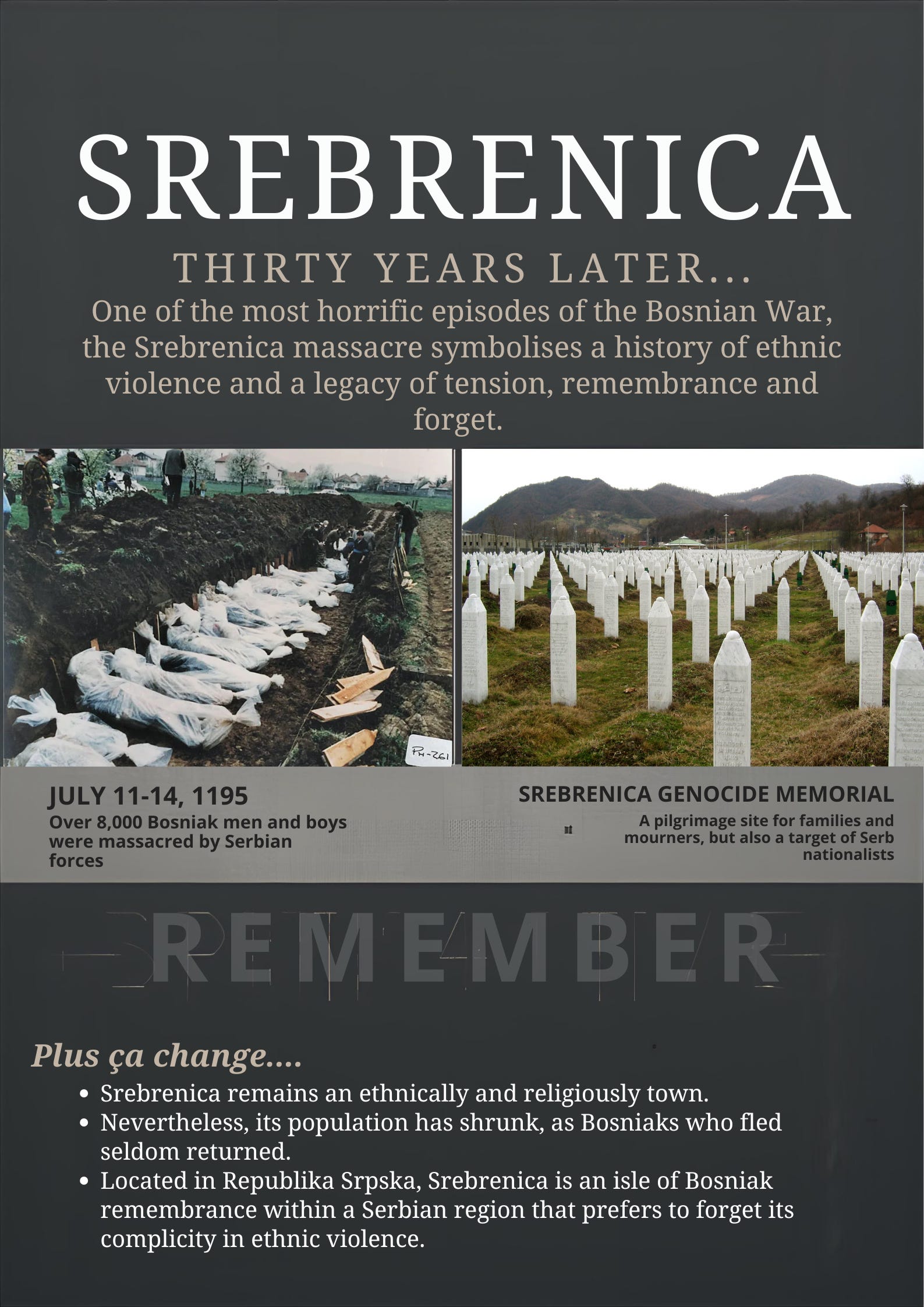
Drive three hours east of Sarajevo, the capital of Bosnia-Herzegovina, and you’ll come across a small, rather non-descript town nested in the dip of a valley. Its houses are capped with red-tiled roofs, and the bell towers and minarets that crown its shabby skyline appear tiny beneath the watchful mountains. Dusty streets meander past derelict buildings and café terraces where old men sit around rickety tables, sipping Turkish coffee and taking languid draws on cigarettes. A little ways away from the town, rows on rows of white gravestones march up a gentle slope. Beside them, giant slabs of marble rattle off the names of the dead.
This is Srebrenica. In the 1990s, its name became a byword for hatred, horror, death and destruction. In July 1995, Serbian forces cordoned the town off from the rest of the world, massacred some 8,000 Muslim men and dumped the corpses into shallow graves. The Srebrenica massacre is the most famous of many communal killings that took place over the course of the Bosnia War, which pitted Orthodox Serbs against Muslim Bosniaks. The war in Bosnia was one of the many spasms of violence that accompanied the downfall of Yugoslavia, a multi-ethnic, pluriconfessional communist republic in the Balkans that ended up fissuring along ethnic lines. A peace agreement signed in Dayton, Ohio, in 1995 put a lid on the conflict by inventing a new country, Bosnia and Herzegovina, which it divided into two administrative regions: the Federation of Bosnia and Herzegovina, populated mostly by Bosnian Muslims, and the Republika Srpska, populated mostly by Orthodox Serbs.
For thirty years, the peace has held. But Bosnia remains a divided society. The central government is largely ineffectual, and its decisions are subject to the scrutiny of an unelected, foreign-appoined High Commissioner, empowered to strike down laws and fire ministers. Ethnic spats are not uncommon. A more authoritarian, Russia-friendly Serbian government has galvanised separatist movements in Republika Srpska, barring the road to greater integration with Western Europe. For many Bosnians, the wounds of 1995 are still raw. Resurfaced allegations that wealthy clients paid Serbian officials to go on human safaris in Sarajevo has caused an umpteenth re-examination of the ethnic violence many wish to brush aside.
Srebrenica embodies the contradictions of the Bosnian peace and the difficulties of healing a nation in trauma. Thirty years have passed since the slaughter, and in some respects, the town has not changed much since the pre-war days. Orthodox children still pile into church for Sunday mass, and the muezzin’s voice rings out high and clear over the terracotta tiles. But much of what was destroyed in the war has never been rebuilt. Bombed-out apartment blocks slouch along the dusty high street; giant holes in their walls gape where the windows once were. Restitution for property damage has never been paid. Corruption and neglect trap reconstruction efforts in slow molasses.
Other troubles loom. Despite being a majority Muslim Bosniak town, Srebrenica is located deep within Republika Srpska, near the border with Serbia. Its population, thousands-strong before the Bosnian War, has shrivelled to a mere 800. Since the war’s end, ethnic Serbs have peopled the houses abandoned by fleeing Bosniaks, heightening the sense of isolation among the Bosniaks who have remained. Young people have trickled away, enticed by better prospects in Berlin, London and Paris, and left an old, poor population. When the town’s population does swell into the thousands, it is on July 11. That, families gather at the Srebrenica Genocide Memorial, before those interminable rows of obelisk-shaped gravestones. Often, they come together to rebury what remains of their dead loved ones–a bone, a spare leg. Tensions with Serb officials flare around this time, as much of the Serbian leadership and population deny that the killings took place, or glorify it in song. The leader of Republika Srpska, Milorad Dodik, referred to the killings as an “arranged tragedy,” and a hacker renamed the Genocide Memorial to “Ratko Mladić Park” on Google Maps. As head of the Army of Republika Srpska, Ratko Mladić personally oversaw the killings at Srebrenica. He is currently serving a life sentence at The Hague for genocide and crimes against humanity.
Where justice and retribution exist, they are limited and minimal. Many of the leaders of the Republika Srpska forces faced trial and imprisonment, usually by international tribunals. Soldiers who took part in the massacres, however, often got off scott free, or overturned their convictions on appeal. Some 100,000 Bosnian children were born of war rapes, fathered by rampaging Serbian soldiers who seldom faced any punishment for the exactions they took on Bosnian women. Abandoned, some of these children–like Alen Muhic, the subject of a profile in Le Monde–were taken in by other families and cut off from their native communities.
In processing group trauma, memory plays a crucial role. Recovered artefacts, testimonies, photographs and journals firmly ground the atrocities in the realm of fact. Take an obvious example: as his forces liberated Buchenwald concentration camp, U.S. army general Dwight Eisenhower ordered his men to meticulously document the horrors, so that there could be no doubt as to the nature or severity of Nazi crimes. Museums, memorials and exhibitions serve not only to collect and pass down the knowledge of crimes; they also exist as loci of remembrance and healing. For victims and perpetrators, and their relatives and descendants, these memorials offer the opportunity to decant their sorrow, shock, grief, guilt, anger and hatred into a collective memory-building project.
But when one side–the perpetrators–refuses to admit its role in the killings, the healing can only ever be half complete. Serbian leaders’ refusal to own up to their history means that the Muslims of Srebrenica, engulfed by Orthodox Serbs, are forced to live alone with the grief, anger and resentment of having survived the killings, or of having lost family members to them. Some Bosniaks have chosen to return to their old villages, braving encounters with Serbian neighbours who participated in atrocities against their people. Their anger–against their Serb neighbours, of course, but also against the Dutch-led UN troops that stood by as Bosniaks were being massacred–still simmers. But the fraught political situation means that the remaining Bosniaks have to go about commemorating carefully. The Genocide Memorial has been threatened with bombs, and closed on various occasions, on orders of the Republika Srpska government.
That is the situation of the Bosniaks who stayed. Other Bosniaks have gone away for good, leaving Srebrenica and its rows of obelisk-shaped gravestones to the ghosts.
In this episode Baybars discusses the post conflict experience of Srebrenica and the "half-complete" healing process of a nation where the physical scars of war remain visible. He is a Citizen journalist with us on a placement organised with Oxford University Career Services.
Thank you for reading an A4R 🎨 Post. Don’t forget to try out gaming art NFT’s here. Every purchase scales our impact and pays our bills.


