

At a Glance - Displaced Syrians are using digital platforms to reclaim their identities following the devastation of the Syrian Civil War. Social media enables refugees to preserve culture, maintain family connections and share their own narratives beyond statistics. While inequalities in access persist, digital spaces offer essential opportunities for belonging, visibility and cultural reconstruction.
Backstory
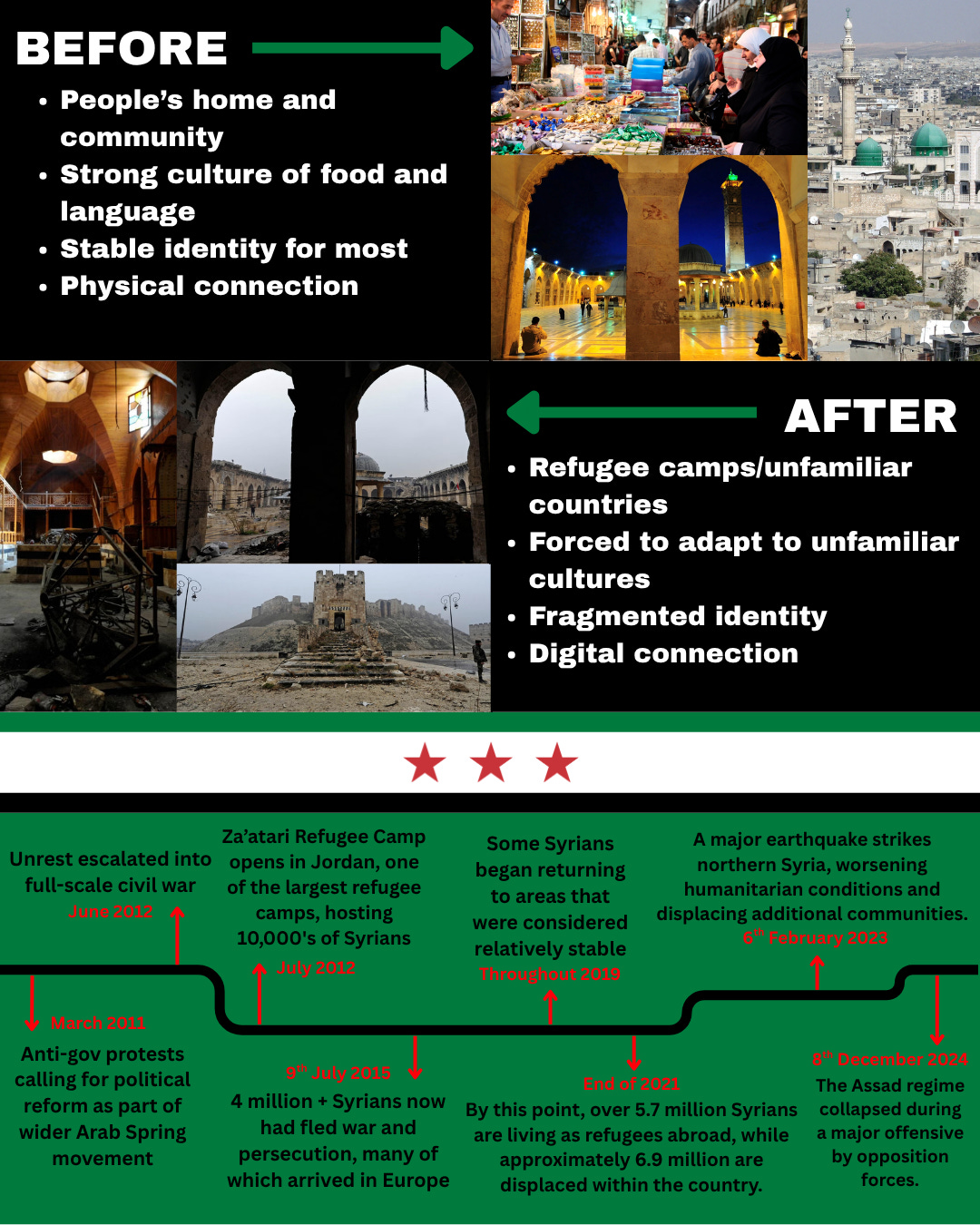
More than a statistic: How Syrian Refugees are Reclaiming their Voice Online
Culture is made up of many aspects, including language, food, customs, land and values, just to name a few. It exists in both intangible and tangible forms, shaping how we see ourselves and where we belong. However, what happens when war and conflict infiltrates that culture, destroying your land, disrupting the processes of customs and making food and forcing you to flee to places where the language, values and sense of belonging are no longer the same?
For millions of Syrians displaced by the Syrian Civil War, this question is not theoretical, but in fact it is their reality. With more than 12 million Syrians forcibly displaced and millions more still living in unstable conditions, the conflict has not only reshaped the country physically but has deeply fractured its sense of identity. In a context where collective trauma has ruptured national belonging, identity is no longer something stable in Syria, but something that must be rebuilt.
This article explores how displaced Syrians are navigating this loss, not just through physical rebuilding, but through digital spaces. In a world where being seen and heard is increasingly tied to an online presence, social media has become an extremely powerful tool for reclaiming one’s voice, preserving culture, raising awareness and in rebuilding a sense of identity in the aftermath of a conflict.
For many young people in the UK, identity is something we express daily, through what we post, what we wear, the music we listen to and the communities we are a part of, both online and offline. Social media has become a space where we shape how others see us and in turn, how we see ourselves. Now imagine that being taken away, except it’s not just your online presence, but your home, your livelihood, your community and your everyday routines that make up who you are. Considering aspects like choosing what to wear to best represent ourselves as an active daily determining factor of our identities is a privilege. For displaced Syrians, identity is not just about self-expression but about something that requires rebuilding.
War does not just destroy infrastructure, it disrupts meaning. In Syria, years of conflict have fractured what researchers describe as ‘collective identity’. This is the concept of a national identity of a nation as a whole or the shared sense of belonging that binds people together. This rupture is not only physical but deeply psychological, creating collective trauma, where the very idea of what it means to be Syrian is thrown into question. As a Syrian woman, named Fadia, reflected, “our identity as Syrian women has become intertwined with this narrative of war”. It is inevitable for culture to evolve and undergo massive transformations over time, whether it is a culture of a specific city or a whole nation in question. This change is natural and results due to the fact that culture is malleable. It is a dynamic and adaptive system, in which people adjust according to their environments, technologies, ideas and social behaviours. However, what occurred in Syria was far from natural, leading to the loss of people’s identity, as a result of politicization.
In Syria, this disruption was not caused by conflict alone but also by years of political control that shaped how culture could be expressed. Cultural identity was often tied to state narratives, limiting how freely people could explore and share their traditions and perspectives. When conflict escalated, this already fragile cultural space was further damaged, through destruction of cultural landmarks and communities. As a result rebuilding culture is not simply about returning to the past but about redefining what it means to be Syrian in this completely new context. Only recently, in the aftermath of the conflict, have Syrians begun to reclaim these spaces, using art, literature and storytelling to redefine what their culture means. The Ministry of Culture has taken steps to help reignite cultural institutions by co-ordinating exhibitions and festivals and cultural centres have even reopened.
For many displaced Syrians, rebuilding their identity is no longer confined to physical spaces. It is now happening online as social media platforms have become vital tools for communication and survival. Digital platforms that many take for granted in their daily life are necessary lifelines for some, that allow refugees to maintain connections with family, document their experiences and share these stories with a global audience. This is helping to rebuild Syrian culture in many ways, firstly being able to maintain a connection with their family means that they can maintain their language and the recognition of customs, whilst feeling less isolated in a new foreign country. Having the autonomy to be able to document and share their own experiences, displaced people or refugees can take control of their own narrative and show that being Syrian is more than the war and conflict that unfortunately took place.
In many ways, this mirrors how Gen Z already uses digital spaces. Platforms like Instagram or Tiktok are not just for entertainment but where identities are shared and validated. The difference is that for refugees it does not follow a monetary purpose of building a personal brand and gaining followers but about maintaining a sense of self in the face of displacement and possibly raising awareness for their country and its people. What might feel like a casual scroll past a pose could be a lifeline for another person.
Instead of being reduced to statistics, individuals are able to present themselves as students, artists, workers and creators. In this sense, digital spaces fulfil a fundamental human need, which is the need to be heard. As one refugee described, being able to see and speak to their family through social media makes it feel “as if they live with us”, highlighting how technology can restore a sense of closeness even in displacement. Additionally, social media can also further the reconstruction of culture within Syria through raising awareness and online funds and resources.
Beyond voice, digital platforms also help rebuild another essential human need: connection. Displacement often means losing entire support systems, which can even happen overnight, including family, friends and community networks. Social media helps bridge this gap, allowing refugees to maintain relationships and form new ones across borders. Studies show that refugees rely heavily on digital tools to navigate daily life, learn new cultural norms, keep in touch with family and integrate into host communities, with over 80% of Syrian refugees in Turkey in a 2023 social media study reporting increased knowledge of their new environments through social media use.
Belonging is one of the most fundamental human needs and it is also one of the easiest to lose in a conflict. Displacement often means stepping into environments where you could be seen as an outsider, where your language may not be understood or your experiences are difficult for others to relate or respond to. In these moments, digital spaces can offer you a sense of familiarity and community. A shared post, a message from a friend that does understand, hearing your own language online even if it is through a TV show or being able to speak to your family can provide immense levels of comfort and continuity. These small moments help to rebuild a sense of normality, reminding individuals that they are still connected to something larger than their immediate surroundings.
However, digital identity is not a complete solution. Access to technology is uneven and not all refugees have the resources or stability needed to maintain an online presence. Research suggests that many feel the need to appear ‘resilient’ or ‘deserving’ in order to be accepted by host societies, shaping how they construct their identities digitally. This raises important questions on whose voices are truly being heard and whose are left out? While digital platforms offer opportunities for visibility, they can also reinforce inequalities and expectations. It cannot be ignored that some refugees may not even wish to present themselves online.
Despite these challenges, digital identity continues to play a growing role in how post-conflict communities rebuild. As technology becomes more integrated into everyday life, these online spaces may increasingly shape how culture, identity and belonging evolve across borders. For younger generations of Syrians, particularly those who have grown up in displacement, their concept of identity may no longer be tied to a single place, both physically and digitally.
The story of Syrian refugees is often told through facts and numbers, millions having been displaced and billions needed in funding for post-conflict reconstruction, but these figures fail to capture what is also at stake: identity, belonging and their basic human needs of recognition and connection. In the aftermath of the Syrian Civil War, digital spaces have become more than just tools and instead places where people have the opportunity to rebuild who they are. These platforms cannot replace what has been lost but can offer something essential, which is the chance to be seen, heard and to remind the world that behind every statistic is a human story not yet finished.
Bibliography:
Al-Daher, Yaser. “Syria in Transition – the Return of Syrian Culture.” Syriaintransition.com, 2026. https://www.syriaintransition.com/en/home/opinion/the-return-of-syrian-culture.
Aldamen, Yasmin. “Understanding Social Media Dependency and Uses and Gratifications as a Communication System in the Migration Era: Syrian Refugees in Host Countries as a Case Study.” Social Sciences 12, no. 6 (June 1, 2023): 322. https://doi.org/10.3390/socsci12060322.
Bachleitner, Kathrin. “Collective Identities amid War and Displacement: Syrians and Syrian Refugees Re‐Imagine Their Country.” Nations and Nationalism, December 14, 2021. https://doi.org/10.1111/nana.12788.
data.unhcr.org. “Country - Syrian Arab Republic,” n.d. https://data.unhcr.org/en/country/syr.
Sciaf.org.uk. “Rebuilding Lives in Syria: Fadia’s Story | SCIAF,” 2022. https://www.sciaf.org.uk/about-us/news/14-rebuilding-lives-in-syria-fadia-s-story.
Udwan, Ghadeer, Koen Leurs, and Amanda Alencar. “Digital Resilience Tactics of Syrian Refugees in the Netherlands: Social Media for Social Support, Health, and Identity.” Social Media + Society 6, no. 2 (April 2020): 205630512091558. https://doi.org/10.1177/2056305120915587.
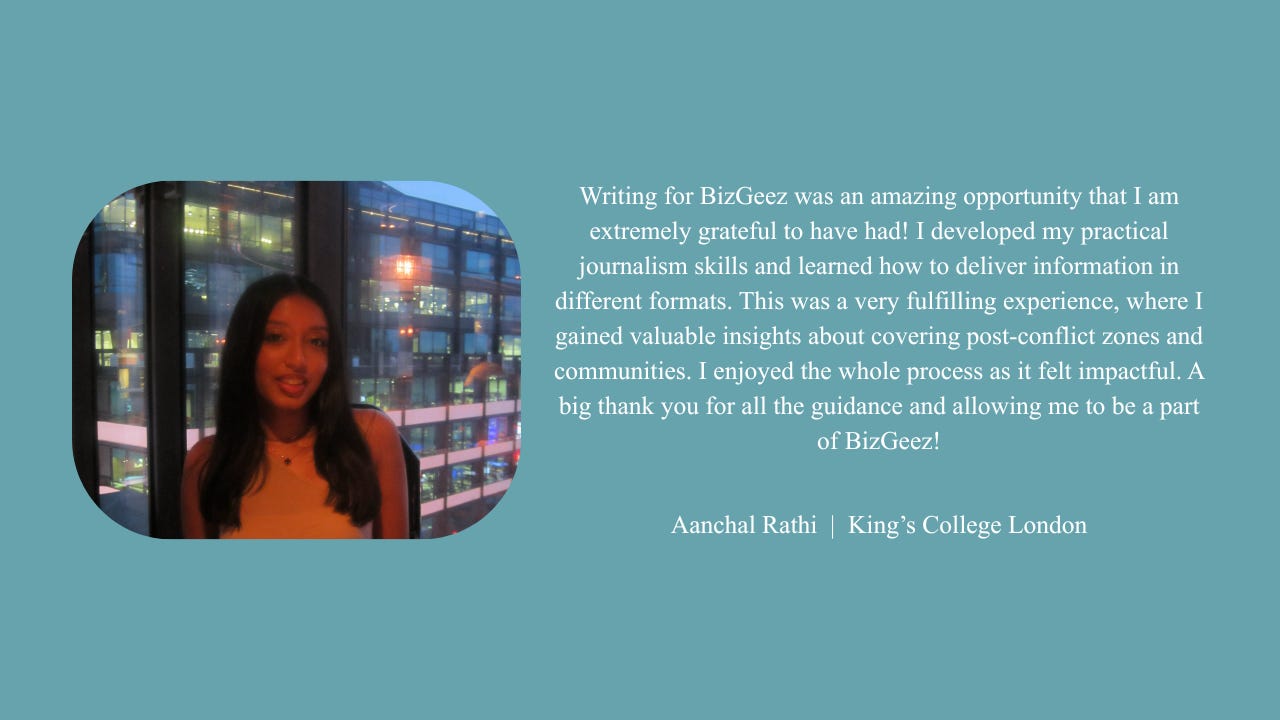
In this episode Anachal discusses how displaced Syrians are using digital platforms to recliam their identities given the devistation of the cicvl war there. She is a Citizen journalist with us on a placement organised with Department of War Studies, King’s College, London.
Thank you for reading an A4R 🎨 Post. Don’t forget to try out gaming art NFT’s here. Every purchase scales our impact and pays our bills.


