


Reunification in 1975 brought official unity to Vietnam but left families grappling with "re-education" camps and silenced histories. Without explicit reconciliation or public closure, healing emerged through endurance and practical adaptation. Today, stability exists not through resolved memories, but through the quiet necessity of moving forward together.
Backstory
They Told Vietnam to Forgive. But No One Explained How.
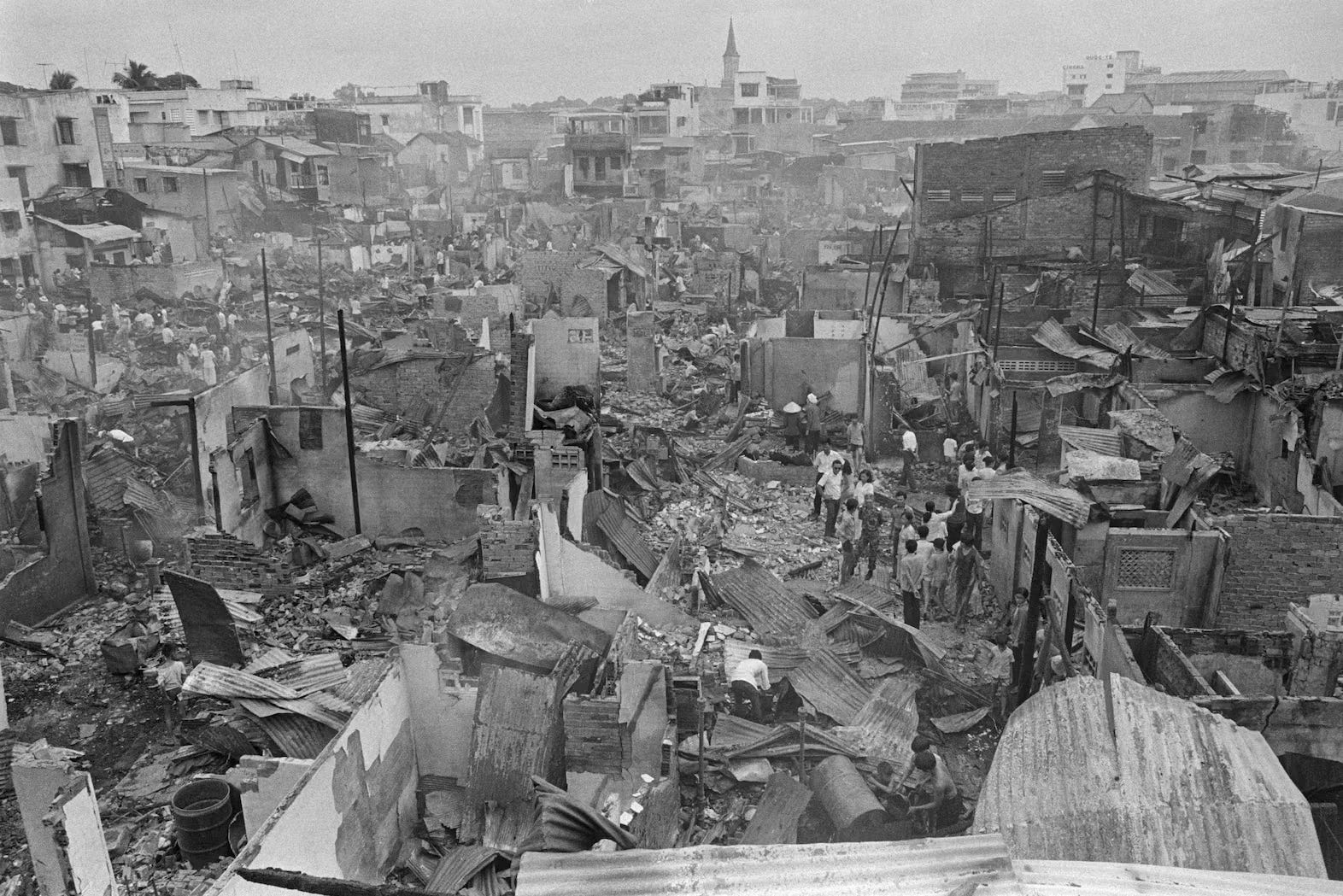
The first rocket attack hitting Saigon struck the town center and set fire to 150 wooden houses. Fourteen died and over 40 people were injured in the attacks. Inhabitants of Saigon woke up to the devastation of war on April 21, 1975. Jacques Pavlovsky
On a humid evening in Ho Chi Minh City, a grandmother folds away a photograph she never displays. In it, her older brother stands in a uniform that no longer exists, the army of South Vietnam. He disappeared in 1976, taken to a re-education camp after the war, and never returned. His grandchildren do not know his name, not because it was forgotten, but because some stories are easier to live with when they remain unspoken.
For many families in Vietnam, the war did not end cleanly in 1975. Officially, reunification marked a moment of closure, a transition into unity and stability. On paper, it was a clear outcome: one country, one people, one future. But beneath that narrative, reality unfolded differently. Families had lived on opposing sides of the conflict, not only geographically, but politically and emotionally. For some, reunification brought a sense of victory. For others, it introduced loss, uncertainty, and a quiet redefinition of identity that could not be openly expressed.
In the years that followed, hundreds of thousands of people connected to the former South were sent to re-education camps. These were not distant or abstract institutions; they were deeply personal disruptions that reshaped families and communities. Men disappeared for months or years, often without clear information about their fate. Those who returned carried experiences that were rarely spoken about, shaped by hardship, surveillance, and a lingering sense of vulnerability. Over time, these experiences were not erased, but absorbed into silence. Stories became fragmented, softened, or withheld entirely, creating gaps that would later define how younger generations understood, or failed to understand the past.
This silence did not emerge by accident. It became a way of navigating a reality where certain histories were difficult to explain and, at times, risky to articulate. Within families, it shaped conversations, defining what could be shared and what remained unspoken. Children grew up sensing the presence of something unresolved, learning indirectly that some questions did not have simple answers. In this way, memory itself became uneven, carried forward not through open dialogue, but through absence, hesitation, and partial understanding.
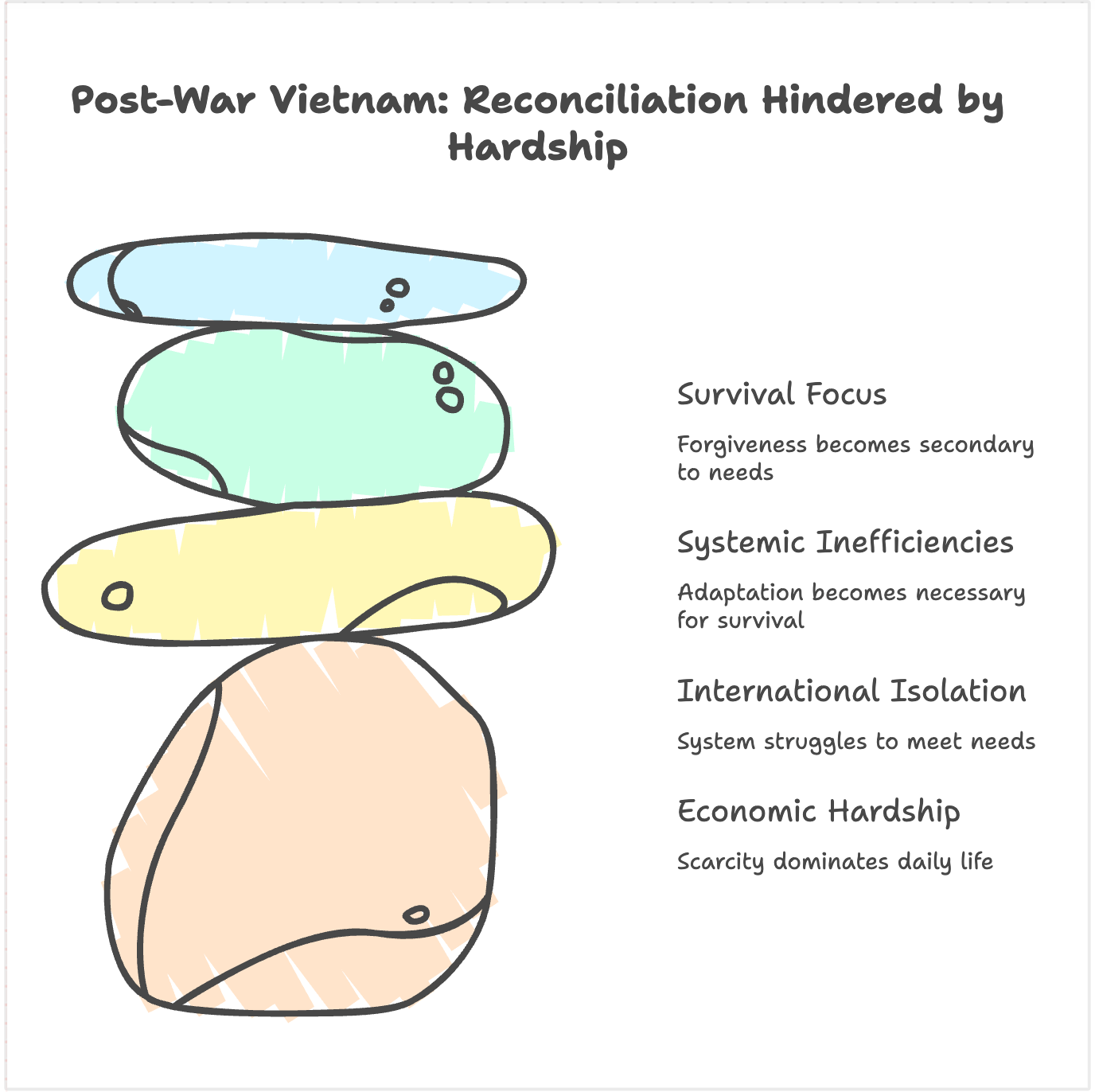
At the same time, the broader context of post-war Vietnam made emotional reconciliation even more complex. The late 1970s and early 1980s were marked by severe economic hardship, international isolation, and systemic inefficiencies. Daily life was defined by scarcity of food, of resources, of certainty. Under these conditions, survival became the primary concern, and when survival dominates, abstract expectations about forgiveness or reconciliation begin to lose their immediate relevance. People were expected to follow the system, but the system often struggled to meet basic needs. As a result, adaptation became necessary.
Informal markets emerged. Personal networks became essential. Decisions were shaped less by ideology and more by practicality. These were not acts of resistance, but responses to constraint, ways of navigating a system that could not fully support everyday life. In this environment, the idea of forgiveness did not disappear, but it became secondary to more immediate concerns. The question was no longer how to reconcile the past, but how to continue living in the present.
What developed in Vietnam was not a visible process of reconciliation, but a quieter form of coexistence. People lived side by side, worked together, and rebuilt their lives, even when trust was incomplete and memories remained unresolved. Conversations were often shaped by what was left unsaid, and relationships were maintained through a careful balance of acknowledgement and avoidance. This was not the kind of reconciliation that appears in official narratives or international frameworks. It did not rely on public apologies or collective moments of closure. Instead, it relied on endurance, the ability to maintain stability without fully resolving the past.
By the mid-1980s, however, it became clear that adaptation at the individual level was not enough to sustain the country as a whole. The economic system was under increasing strain, and the gap between policy and reality had become impossible to ignore. The introduction of the Đổi Mới reforms in 1986 marked a turning point, opening the economy and allowing forms of market activity that had already been taking place informally. These reforms are often described as a strategic shift, but they can also be understood as a recognition of lived reality. People had already been adapting, already finding ways to survive beyond rigid structures. The reforms did not create change as much as they acknowledged it.
This moment highlights a broader pattern in Vietnam’s post-war recovery. Transformation did not begin with ideological consensus or moral agreement. It began with practical adaptation, with individuals making decisions based on necessity rather than principle. When policy eventually aligned with these practices, change accelerated. Economic growth followed, cities expanded, and Vietnam gradually reconnected with the global economy.
Today, the contrast is striking. Vietnam is often described as dynamic, youthful, and forward-looking. Urban spaces are filled with energy, with students, entrepreneurs, and new forms of creativity. Cafés, businesses, and cultural spaces reflect a society that is increasingly connected to the world. Relationships with former adversaries, including the United States, have evolved into partnerships, shaped by shared interests rather than historical divisions.
And yet, the past remains present, though not always visible. It exists in the spaces between conversations, in the stories that are not told, and in the silences that continue to shape family life. The absence of open confrontation with certain aspects of history does not mean they have been resolved. Instead, they have been integrated into everyday experience, influencing how people relate to one another and how they understand their own histories.
This challenges a common assumption about post-conflict recovery—that healing requires closure, that reconciliation must be explicit, and that forgiveness is a necessary condition for peace. Vietnam suggests a different possibility. It shows that stability can emerge without full resolution, and that coexistence does not always depend on shared narratives or mutual understanding. Rather than eliminating differences, people learn to live with them.
The grandmother still keeps the photograph. It is not displayed, not discussed, but it is not discarded either. It remains as a quiet reminder of a past that cannot be fully explained, a memory that exists without being fully articulated. For younger generations, this creates a different kind of inheritance—not one defined by direct experience, but by partial knowledge and unspoken histories. They grow up in a Vietnam that feels open and full of opportunity, yet shaped in subtle ways by what came before.
What emerges from this is not a story of complete reconciliation, but of continuity. Life continues, even when the past remains unresolved. Families rebuild, relationships form, and societies move forward, not because everything has been healed, but because it becomes necessary to keep going.
This reframes the idea of healing itself. Rather than a clear endpoint marked by forgiveness or closure, healing appears as an ongoing process which is uneven, incomplete, and often invisible. It can take the form of silence, not as denial, but as a way of managing complexity. It can appear as compromise, as the decision to prioritise stability over confrontation. It can exist in the ability to carry unresolved memories without allowing them to dominate the present.
There is an uncomfortable truth in this. The belief that moral clarity leads to action—that if something is right, people will follow it does not always hold. Vietnam reveals the distance between ideals and lived reality, showing that human behaviour is shaped not only by values, but by constraints, pressures, and the need to adapt. Forgiveness may be desirable, but it is not always possible, and it is not always necessary for societies to move forward.
In the end, Vietnam was not rebuilt through a single moment of reconciliation or a collective act of forgiveness. It was rebuilt through countless small decisions, choices to stay, to adapt, to remain silent, and to continue. These choices did not resolve the past, but they made it possible to live with it.
And perhaps that is what healing often looks like. Not closure, not perfect understanding, but endurance. Not the absence of pain, but the ability to carry it. Not a finished story, but one that remains open, and still, somehow, allows life to go on.
In this episode Anh discusses the Vietnamese expereince of rebuolding their country and the kind issues they have been dealing with. She is a Citizen journalist with us on a placement organised with Department of War Studies, King’s College, London.
Thank you for reading an A4R 🎨 Post. Don’t forget to try out gaming art NFT’s here. Every purchase scales our impact and pays our bills.


