


Planting Seeds of Prosperity: Agricultural Challenges in Vietnam’s Post-War Recovery
Rolling fields. Arcyteryx jacket on. Romance with your Easy Rider budding. The Ha Giang Loop is one of the most talked about destinations for backpackers travelling through South East Asia. However, what often goes undiscussed in these travel recommendations is the way of life in the Ha Giang region, and the utility of the region for the country’s economy. Ha Giang is one of the poorest provinces in Vietnam, and yet it is an essential part of Vietnam’s agricultural industry. Rich in rice, maize and fruits, Ha Giang is populated by communities who employ traditional farming techniques to harvest these products. The contrast between these two images of Ha Giang is striking, and this article aims to draw attention to this second, less-discussed picture.
This piece focuses on one of the most basic human needs—food security—and asks how war, policy and environmental damage has shaped Vietnam’s ability to meet it. Agriculture was an essential tool in rebuilding the Vietnamese economy after the war, and a series of different initiatives implemented by the Vietnamese government in this period led the sector on a journey through scarcity to surplus. The effects of the war, however, lingered through this process, and still impacts the agricultural industry today.
The Vietnam War spanned twenty years, officially beginning on November 1st 1955 and ending on April 30 1975. The conflict took place between the divided North and South. The North Vietnamese government aimed to establish a communist system for the country, and this government had the support of some in the Southern Region, known as the Viet Cong. In opposition to this, the government of South Vietnam was vying for a system more closely aligned with the countries in the West. Subsequently, they gained the support of the US, who entered into the conflict in 1965. With the USSR and China pouring weapons into North Vietnam, and the aforementioned US presence in this conflict, the Vietnam War is considered a manifestation of the Cold War.
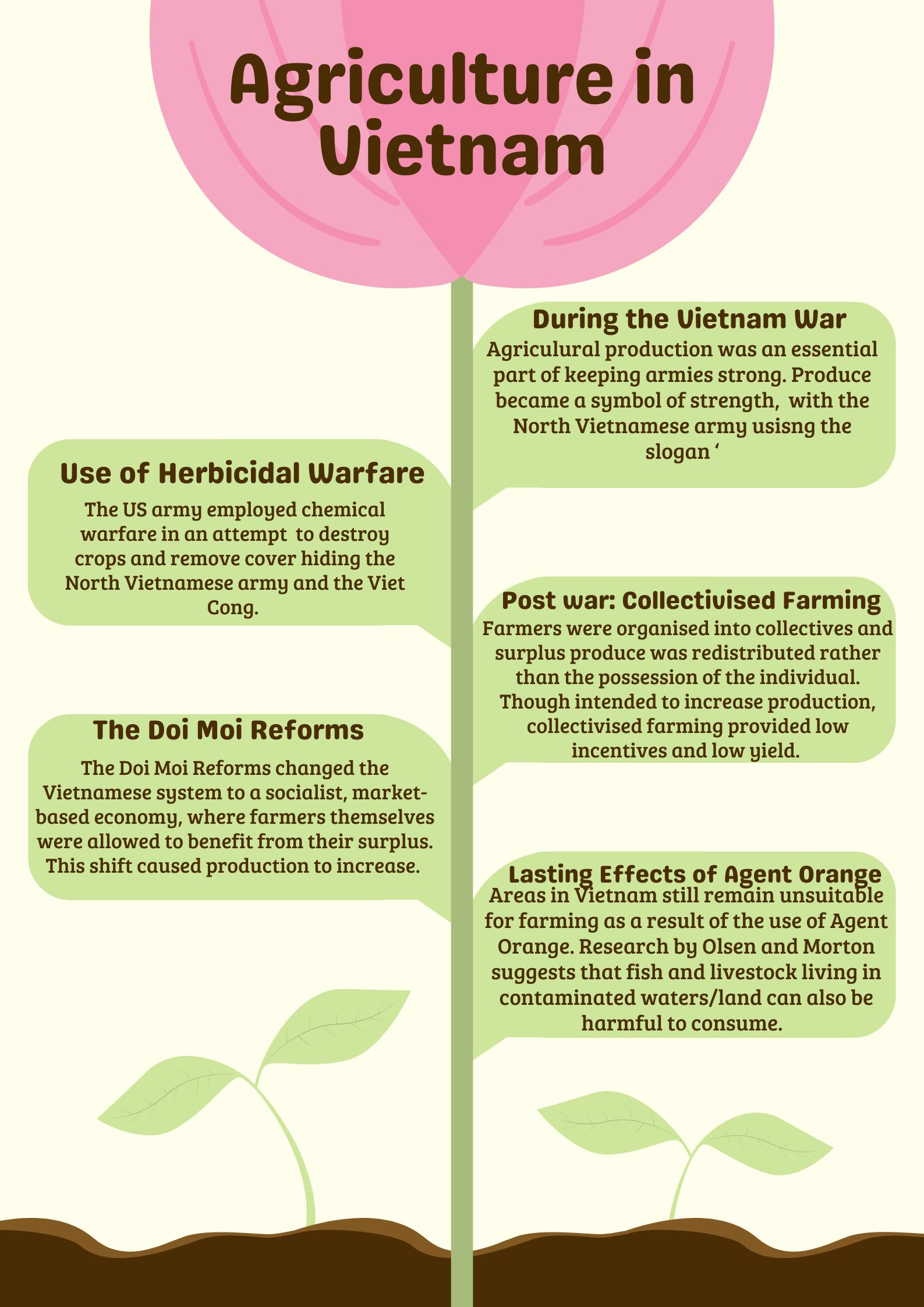
During this conflict, agriculture was central to warfare. In North Vietnam, produce was reserved for fighters, with the popularised slogan, ‘every grain of rice and every soldier was ensured for the frontline’ prompting a surge in rice farming. Agriculture became a key factor in keeping soldiers alive and strong, and subsequently it became a symbol of strength.
Countering the necessity of food for the war effort, the US involvement in the conflict fought against this production with the employment of chemical weaponry. With multiple different chemicals used, the most famous and impactful of these was dubbed Agent Orange - a herbicide intended to destroy crops and remove vegetation that was helping to cover North Vietnamese soldiers and the Viet Cong. This was the biggest deployment of herbicidal warfare in history. However, Agent Orange was found to produce a toxic byproduct, called dioxin TCDD. This product poses risks to human health, and has been linked to a wide range of complications including cancer and cardiovascular diseases.
These lasting effects of Agent Orange meant that not only did agriculture and farming play an essential part in the war strategy itself, but the employment of chemical weaponry by the US would go on to affect the agricultural systems of the nation for the foreseeable future.
After the war ended, the newly instated communist government turned to agriculture as a means to boost the post-war economy. As part of a wider movement to a centralised socialist economy, the government introduced an initiative to collectivise farmers. Individual ownership of land was revoked from farmers, and instead they were grouped into cooperatives. They were instructed to work on the premise that any surplus crop they produced would be turned in and redistributed centrally. The theory was that this would increase production and resources for the nation. This initiative, however, had the inverse effect. Low incentives resulted in low yields, and low harvest numbers forced the government to start importing food.
The failure of this system was then overridden in 1986 when the Doi Moi reforms were put in place. With the country falling into economic crisis as a result of the centralised economy, the government elected to change their approach, turning to a market-centred, socialist economy. Part of this movement was to decollectivise farming in Vietnam. The state restored private land use rights and allowed individual farmers to sell on the market. As a result of these reforms, the agricultural industry began to flourish. This policy re-aligned incentives — motivated by the idea that they could keep and sell surpluses, production rose quickly. Vietnam moved from importing rice in the late 1980s to becoming a leading exporter within a decade. Looking at rice production alone, for example, in 1989, Vietnam exported 1.4 million tonnes of rice.
This flourishing agricultural industry has only grown in the last 30 years, contributing to the strengthening of the Vietnamese economy post-war. According to The Ministry of Agriculture and Environment of the Socialist Republic of Vietnam, in 2025 Vietnamese rice was exported to over 160 countries across the globe.
However, the booming agricultural industry now is not entirely free from the ghosts of the Vietnam War. The use of Agent Orange throughout the conflict has led to long term effects that echo in the agricultural industry even today. Dropping an estimated total of 19 million gallons of chemicals over South Vietnam, hectares of farmland were affected in the millions. One of the problems with the dioxin TCDD in Agent Orange is that its half-life can span up to 100 years. Its persistence means much of the land remains contaminated today, and still unsuitable for farming. Olson and Morton have undertaken research into the impact of Agent Orange on the landscape in Vietnam, and note that dioxin TCDD from the herbicides made its way into the environment in Vietnam. The problem with this chemical is, once it has entered the landscape, it can take between decades and centuries to leave.
Not only does Agent Orange leave the land unsuitable for farming, but Olson and Morton have also explored how its absorption into the soil has resulted in the contamination of marshes, lakes and rivers. As a result of this, it is not only crop directly grown through this land that poses a risk to citizens, but fish and livestock living from contaminated waters and fields. Ingestion of any of these foods can prove seriously harmful. These two levels of localised and lower-level contamination mean some communities have been faced with acute exposure whilst others have lived with elevated long-term risk. As a result of these layers, the agricultural industry is experiencing the effects of Agent Orange on multiple levels.
The scar that Agent Orange has left upon the agricultural industry serves as a reminder of the time in which agricultural production was not flourishing in the way it is now. The war’s environmental imprint complicates Vietnam’s agricultural success story: production and exports have risen, though risks from contamination persist.
Bibliography
National Center for Biotechnology Information (NCBI). Chapter (online): “The U.S. Military and …” in Veterans/Agent-Orange–related volume. https://www.ncbi.nlm.nih.gov/books/NBK236347/#:~:text=3The%20U.S.%20Military%20and,nature%20of%20their%20job%20assignments. Accessed 20 Mar 2026.
Olson, K., & Morton, L. T. “Long-Term Fate of Agent Orange and Dioxin (TCDD) Contaminated Soils and Sediments in Vietnam Hotspots.” (report/working paper). (n.d.). https:// (please supply year, publisher, DOI or link if available). Accessed 20 Mar 2026.
Socialist Republic of Vietnam, Ministry of Foreign Affairs. “Vietnam’s agriculture shifts from quantity to quality to win new markets.” https://en.mae.gov.vn/vietnams-agriculture-shifts-from-quantity-to-quality-to-win-new-markets-9039.htm. Accessed 20 Mar 2026.
WTO Center. “80 years on: Vietnam emerges from rice importer to top 3 global exporter.” https://wtocenter.vn/chuyen-de/28581-80-years-on-vietnam-emerges-from-rice-importer-to-top-3-global-exporter. Accessed 20 Mar 2026.

In this episode Leya discusses the post conflict experience of Vietnam. She highligts the food security issues the local population face decades after the war ended. She is a Citizen journalist with us on a placement organised with Oxford University Career Services.
Thank you for reading an A4R 🎨 Post. Don’t forget to try out gaming art NFT’s here. Every purchase scales our impact and pays our bills.


