


Following the 2024 conflict, Lebanon faces a profound mental health crisis. Severe trauma, displacement, and re-traumatization affect millions, especially children. Recovery is hindered by destroyed infrastructure, "brain drain," and cultural stigma. To ensure long-term stability, the government must prioritize sustainable mental health reform over temporary NGO-led aid.
Healing Lebanon: Addressing Trauma and Mental Health Challenges During Post-Conflict Recovery
From October 1st to November 27th 2024, Israeli forces launched an invasion into Lebanon as part of its escalating conflict and eventual war with Hezbollah over a year-long period. A ceasefire was subsequently brokered between the two parties. Many are hopeful that the ceasefire will become permanent and will prevent further destruction, injury and death in Lebanon. However, Lebanon faces a difficult future ahead, with a severe mental health crisis on its hands. If the ceasefire becomes permanent – or, if not, then when the war concludes – what mental health challenges does Lebanese society face, and what pathways can it take to recover?
The immediate post-conflict challenges: Physical injuries and healthcare infrastructure in ruins
As of November 25th 2024, the Lebanese Ministry of Health has reported 3768 deaths and 15,699 injured since the beginning of tensions in October 2023, most of which occurred after tensions escalated into war. The destruction of Lebanon’s medical infrastructure was particularly severe. On November 26th, the Lebanese Ministry of Health reported that 222 healthcare workers had been killed and 67 hospitals had been attacked. As of November 15th, Israeli attacks had damaged 40 hospitals and 249 emergency vehicles, and eight hospitals are non-functional due to critical damage.
Rebuilding Lebanon’s healthcare infrastructure and providing treatment for physical health and immediate injuries are obvious first steps towards recovery. However, to sufficiently support Lebanese society with their health and with healing in the long-term, the government must also examine and prioritise Lebanon’s troubling mental health crisis.
Lebanon’s post-conflict mental health crisis in children and adults
Beyond physical injuries and their compromised physical health, the war in Lebanon has also culminated in a major mental health crisis, especially in terms of trauma, among civilians.
The war has been particularly traumatising to children and adolescents. The forced closure of schools has deprived them of education, and they are forced to grapple with a lack of basic necessities such as food and water, scenes of violence and the sudden deaths of family members and friends. Younger children, who experience trauma differently due to an inability to express their feelings, can suffer from long-term issues in their development, such as poor cognitive development and behavioural issues. Parents have described their children as having grown up quickly to deal with the death and destruction.
Displacement is also a traumatising experience to both children and adults: a UN report estimates that 1.5 million people were displaced from their homes as a result of airstrikes, which includes 400,000 children. Displacement and the experience of being a refugee have been linked to higher rates of PTSD. The slightest sounds remain triggering to traumatised individuals, who are constantly on edge and prepared to flee, fearful that they could be hit at any moment.
Re-traumatisation in Lebanon and a lack of mental health services
Lebanon’s history of previous wars within living memory creates an added layer of complexity to mental health problems. Lebanese people who lived through the Israeli invasions in 1978, 1982 and 2006 and the Lebanese Civil War (1975 – 1990), as well as Syrian and Palestinian refugees in Lebanon who have fled violence and war, speak of being re-traumatised by the 2024 war. Prior to the 2024 war, studies have found that a quarter of the population was suffering from at least one psychiatric disorder, such as anxiety and depression, and especially PTSD (25%) linked to war trauma. We can expect these rates to be even higher in the aftermath of the 2024 war.
Re-traumatisation will have undone any progress achieved in healing or learning to cope with trauma, anxiety and depression, which was already a difficult process in Lebanon. Previous post-conflict reconstruction efforts by the Lebanese government appear to have focused primarily on physically rebuilding and upgrading infrastructure, such as the Downtown Beirut restoration and upgrade project with Solidère, which began within four years of the end of the Civil War. The government has largely overlooked and delayed reshaping Lebanon’s healthcare system to provide for the newly emerging need for accessible mental health services among Lebanese citizens post-conflict, which will now once again be critical. Public services funded by the government for mental health did not really exist before 2013 despite repeated traumatic wars in Lebanon; mental health, instead, fell to private practitioners. This situation highlights how mental health has largely been neglected during post-conflict periods in Lebanon.
Affordability is a major barrier to accessing existing public mental health services in Lebanon, as these services are mostly only available through these private practitioners that can be expensive, as the government only provides small subsidies for private care. The limited public services that exist – and are restricted to three hospitals – are riddled with problems, from receiving poor government funding amid Lebanon’s economic crisis (only 1% of government funds are allocated to mental health services) to a lack of trained professionals (particularly due to the emigration of professionals abroad for better opportunities, a phenomenon known as brain drain). NGOs, such as Embrace Lebanon, have previously stepped in to fill the large gaps in Lebanon’s mental health services. However, NGOs can only provide temporary relief, as their services are not widely accessible due to limitations in funding and their capacity. These limitations make it difficult to address psychological needs and fill the gaps in Lebanon’s mental health services on a sustainable, long-term basis.
Trauma is a double-edged sword. Individuals and communities suffering from poor mental health face higher rates of poverty, which can further entrench Lebanon’s economic crisis, thus worsening poverty. In turn, impoverished people also face higher rates of poor mental health, creating a vicious cycle that exacerbates both poverty and mental suffering. Lebanon’s need to address its mental health crisis post-conflict is urgent to also bolster their economic recovery as a society.
The issue of stigma
Access to mental healthcare in Lebanon is hindered by the stigma that surrounds mental illness and treatment on different levels.
On a religious and cultural level, it is typical for someone who is struggling to consult a religious leader for advice or to consult religious passages and deepen their prayers for comfort and alleviation. While these strategies may help, some find it difficult to accept that therapy and mental health services can also support someone who is struggling and can be undertaken alongside religious methods.
On a social level, discussing mental health issues is still not as widely normalised in Lebanon as in other parts of the world. Culturally, seeking professional mental health support, as opposed to turning to family and community, is also not as common in many Arab societies, where external support is sometimes viewed as a Western approach. MSF, which is currently providing emergency support in Lebanon, has observed that people are reluctant to speak about their mental struggles.
Gender conventions also contribute to the stigma surrounding men’s mental health in Lebanon. Traditional cultural norms emphasise masculinity, often interpreting it as the need to be emotionally and mentally strong. As a result, seeking professional mental health support may sometimes be seen as a sign of weakness or contrary to ideas surrounding masculinity. This stigma creates additional barriers to accessing mental health support in Lebanon. However, the Lebanese government has recently made efforts to challenge these stigmatic beliefs, including through the launch of the National Mental Health Strategy in June 2024.
Situating government mental health initiatives at the centre of post-conflict recovery
In terms of Lebanon’s immediate needs – rebuilding or restoring healthcare centres and providing emergency support surrounding physical care – NGOs and foreign governments have already mobilised the relevant aid.
As for mental health, it is NGOs that have so far taken the first steps in assisting civilians in Lebanon. MSF is providing services such as therapy sessions and hotlines with specialists. War Child, an initiative that has been providing mental health support to affected children through play, is currently the only organisation providing specialist support for children with war trauma. However, overreliance on NGOs beyond the short-term cannot address Lebanon’s long-term mental health needs, especially as donations and aid tend to dwindle once the emergency recovery period ends.
While it is too early to expect the Lebanese government to fully address the current mental health crisis, especially given the country’s already fragile state following the Israeli invasion, the uncertainty surrounding the ceasefire’s permanence and severe economic crisis, the 2024 war has undeniably exposed critical gaps in public mental health services. These gaps, alongside the lack of development in public mental health infrastructure during past post-conflict recovery efforts, highlight the urgent need for reform and development.
The upcoming recovery process presents an opportunity for Lebanon to prioritise and integrate mental health support into its post-conflict policies, especially as seeking mental health support has become more widely accepted globally and especially among young people, with initiatives already in place to support destigmatisation in Lebanon. The international community must rally together to support Lebanon financially in this task. Situating mental health support at the heart of Lebanon’s long-term post-conflict recovery plans can help to address long-standing issues, improve the well-being of civilians in Lebanon, and circumvent the cycle of poverty and mental suffering born out of trauma.
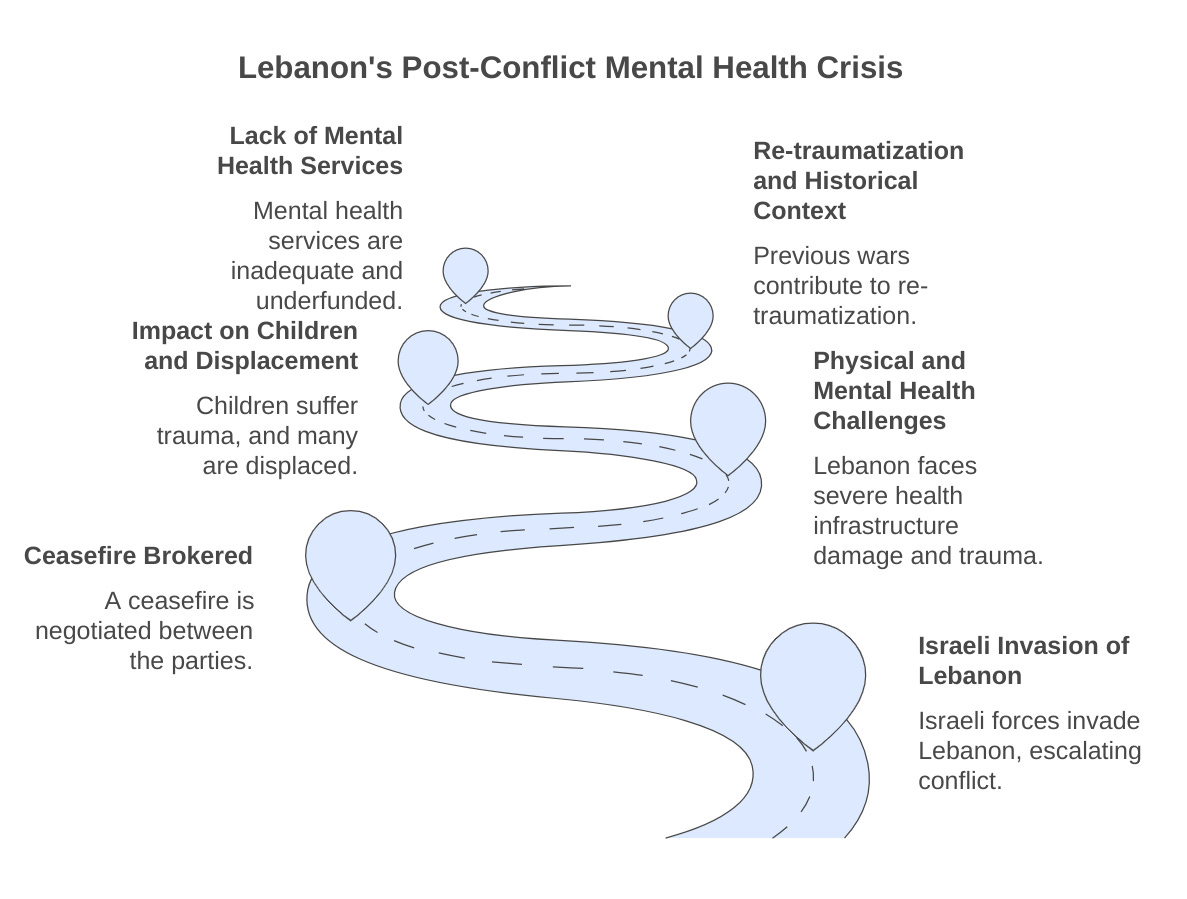
In this episode Tasneem discusses the mental challenges Lebanon faces in the aftermath of its civil war. She is a student journalist with us on a placement organised with Oxford University Career Services. This article was edited using Lex.page. Image with Napkin Ai.
Thank you for reading an A4R 🎨 Post. Don’t forget to visit our gift shop here. Every purchase scales our impact and pays our bills.


