


Gacaca: A lesson in justice.
History
Neighbours, colleagues, friends, and family members, killing neighbours, colleagues, friends, and family members. No safety within homes or communities. No aid from governments. No apparent end to ongoing human tragedy. Incomprehensible atrocities for those who didn’t experience it. This was the horrific reality that characterised a long 100 days for the Tutsi people of Rwanda.
The Rwandan genocide marks a truly dark moment in human history. It was the culmination of decades of conflict and division, sparked in the late 1800s by German and Belgian colonisers who promoted interethnic division. In the years following, an increasingly hostile divide formed between the Tutsi and Twa minority groups and the Hutu majority.
Throughout the 1900s, Rwanda faced much conflict and political instability. The 1959 Rwandan revolution replaced the Tutsi monarchy with a Hutu-led republic, forcing many Tutsi to leave the country. These circumstances led to Rwandan discontent that in turn triggered the 1990 Rwandan civil war between the Tutsi Rwandan Patriotic Front (RPF) and the Hutu government. The war lasted almost four years before President Juvénal Habyarimana established a tenuous peace agreement (the Arusha Accords, 4 August 1993). However, this wasn’t to last.
On April 6, 1994, President Habyarimana was killed when his plane was shot down. The culprits are still unknown, and it’s debated whether the RPF or Hutu extremists killed him. Regardless, this event was instrumental in the start of the Rwandan genocide. Hours after his death, the government’s crisis committee ordered the systematic killing of Tutsi people throughout the country.
The genocide was carried out by the Rwandan Armed Forces and extremist Hutu militias, who killed an estimated 800,000 to 1,000,000 Tutsis and politically moderate Hutus over the course of about 100 days. Furthermore, it is estimated that during the same time frame between 100,000 and 250,000 women were raped. The atrocities only ceased when the RPF overthrew the Hutu government in July 1994.
Recovery in the form of Gacaca courts
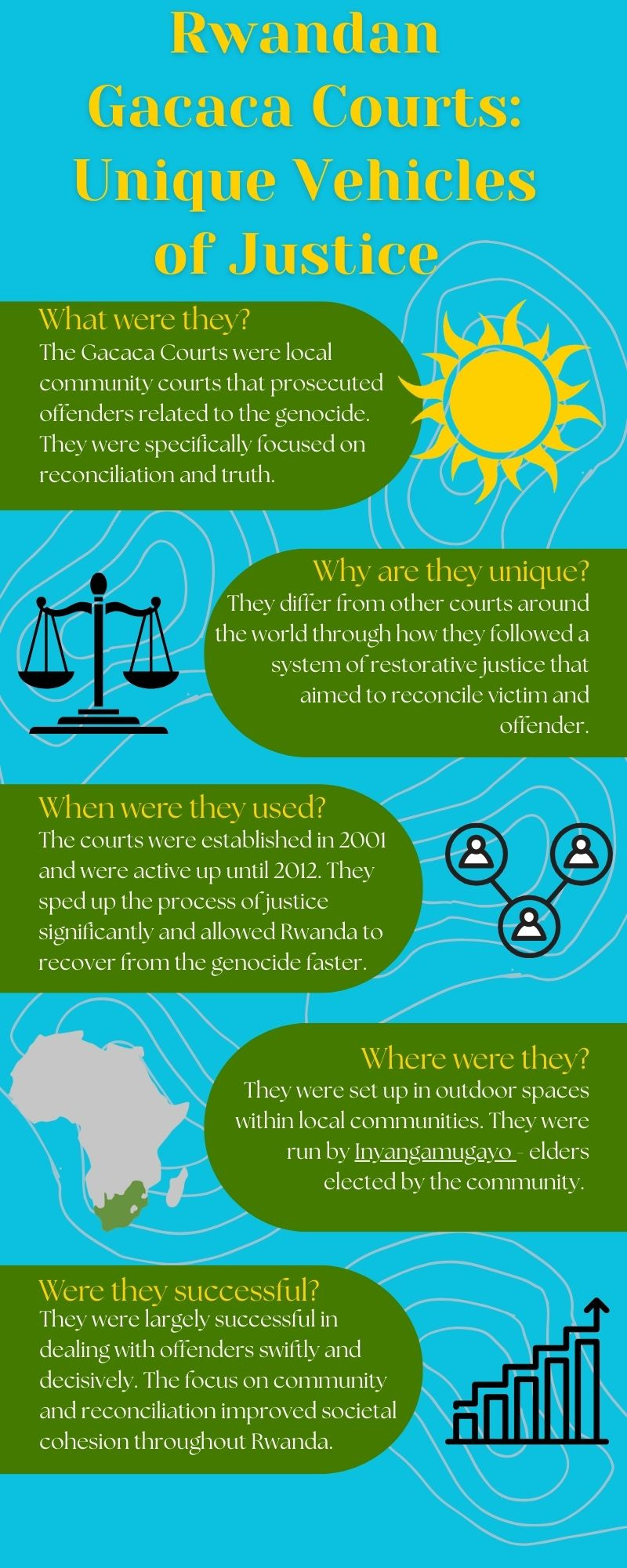
With the Hutu government overthrown and the genocide now at an end, the new Rwandan government had the monumental task of bringing the perpetrators to justice in a torn nation. One of the most difficult problems was the sheer amount of Rwandans accused of genocide-related crimes. Due to the high number of Hutu civilians involved, by 2001 over 120,000 Rwandans were awaiting trial - far too many for the official justice system to handle in a reasonable time.
The establishment of Gacaca courts was the solution for this process of justice. These community courts, held throughout Rwanda, aimed to swiftly address the multitude of accused perpetrators and uncover the truth of the genocide.
The model of the Gacaca courts was a unique one. Originally a way of dealing with local disputes in small communities, they were set up in outdoor spaces for community involvement so victims of the genocide and other community members could be involved in deciding the fate of those involved in the murder of Tutsis. The judges (Inyangamugayo) were locally elected and decided the fate of the accused after hearing evidence from witnesses and the defences of the accused themselves.
Four categories of genocide-related crimes were outlined: Masterminding the genocide and committing acts of sexual violence, participating in the killings, physical assault, and destroying Tutsi property. If the offender was found guilty of the first two crimes, they would be placed within the traditional court system, but if guilty of the latter two, the punishment was in the hands of the Inyangamugayo.
However, what was perhaps most unorthodox in this system was the focus on restorative justice (a focus on reconciliation between victim and offender). The Gacaca courts gave perpetrators an opportunity to explain themselves, confess, and ask for forgiveness from their communities - often leading to reduced sentences.
Were Gacaca courts effective?
Gacaca courts were effective in establishing societal cohesion and in preventing renewed violence. Through the communal aspect of the courts, victims were able to gain emotional security by learning the truth of the events of the genocide. In this sense, the courts were effective in achieving restorative justice
However, the courts were flawed. Rigorous legal processes weren’t followed, evidence was only presented in the form of spoken testimony, and above all, a confession of guilt and an expression of remorse allowed perpetrators to have reduced punishments. From a retributive justice perspective (where punishment for perpetrators is at the forefront of the process), this simply feels wrong.
The 7 Fundamental Human Needs
In answering whether the Gacaca courts were effective in producing real healing within Rwanda, we can look to the 7 fundamental human needs to pinpoint the effectiveness of the courts. These are essential needs for human flourishing that are believed to be cross-cultural and timeless.
Safety/security and survival - The Gacaca courts’ justice acted as a deterrent for future similar crimes and removed dangerous members of society.
Understanding - A key feature of the Gacaca courts was the understanding they provided. By creating an environment for victims to hear offenders speak and hear evidence given, they were able to get to the truth (such as who committed which acts).
Connection (love) and acceptance - As the courts were based in communities and verdicts were reached on a community basis, a deep connection was established within the communities. However, connection was not only found within innocent members of the community, but with guilty members also. And, of course, through the reconciliation, acceptance was also achieved in both victims and offenders.
Contribution/participation - The role of community members (particularly the Inyangamugayo) in the courts is a testament to the contribution people were able to achieve. Furthermore, since the courts finished, people have been able to live in a socially cohesive society that allows them to work as a community.
Esteem, identity, significance - This is an area in which, unfortunately, Rwanda’s recovery from genocide is less successful. Though esteem is not neglected, in the sense that Rwandans are not restricted in their capacity to be recognised as competent and capable, parts of identity are restricted. In the interest of societal cohesion, all references to ethnicity are discouraged within Rwanda. This is problematic as ethnicity is an integral part of identity, particularly after a joint struggle like Rwanda’s.
Self-determination (Autonomy), Freedom, and Justice - Though Gacaca addressed urgent post-conflict needs, lasting autonomy and freedom has not been seen within Rwanda. Rwanda is currently run by an authoritarian state that limits individual freedom significantly through surveillance and political suppression.
Self-actualisation and self-transcendence - Due to the lack of freedom in Rwanda, the ability for self-actualisation and self-transcendence is significantly limited.
Philosophy vs practicality
The use of the Gacaca courts then begs the question: what can we learn from them? And, upon further reflection, we can ask what they teach us as they raise large questions about moral philosophy and justice, and the trade-off between principle and practicality. Should we do things because they are practically useful, even if they are dubious in philosophical principle and consistency? Perhaps the retributive “an eye for an eye” approach is not morally correct.
It’s important to recognise that the negligence of retributive justice in Rwanda was for the sake of societal healing. If Rwanda was to have taken a retributive approach to justice, there is no guarantee that victims would have been able to find peace and that perpetrators would have been able to be reintegrated into society.
Rwandan recovery in a global context
Despite the merits of the Gacaca courts in meeting some fundamental needs, they did not achieve a perfect solution to the country’s issues. Rwanda is under an authoritarian government that greatly limits the political and personal freedoms of its people. It is then up to us to ask whether the authoritarian control of Rwanda is worth the societal cohesion. Furthermore, we should also consider how much of the current social cohesion is due to Gacaca, and how much is due to suppression of freedom?
Other countries that have experienced similar conflicts aren’t in the same position as Rwanda. For example, after the war and genocide in Bosnia and Herzegovina, the International Criminal Tribunal for the former Yugoslavia was set up. This did prove to be effective in dealing with perpetrators, but compared with Rwanda, Bosnia and Herzegovina lack reconciliation as the justice process was retributive and lacked mechanisms to ensure reconciliation. Here justice and principle were placed above societal practicality.
We can also look to the Truth and Reconciliation Commission established after apartheid in South Africa to investigate human rights abuses. Though this was beneficial for reconciliation through open dialogue between victim and offender, the commission resulted in hardly any punishments for perpetrators, leaving victims feeling unsatisfied. This contrasts with Rwanda where both punishment and reconciliation were achieved.
The point in comparing these countries’ responses to conflict is not to determine which is best, but rather to consider where we draw our moral lines. When and why should we abandon practicality? Principles? Justice? What should we favour?
Conclusion
Regardless of the answers to my questions (if there are any), we can certainly learn from the Gacaca courts. Faced with some of the worst crimes, Rwanda prioritised restorative justice, cohesion, and truth over procedural purity. Yes, Rwanda still has problems, but we must give credit where credit is due, and in the case of the Gacaca courts, they provided moral necessity when the country faced societal collapse. The lesson of Gacaca, then, is not that we should always prioritise practical benefit over philosophical consistency, but that in desperate times it may be necessary to focus on practical healing as a moral priority.
Resources list
Acha, D.K., MD and DMin. (2015). The 7 Fundamental Human Needs | Servants University | Training Servants for Christ. [online] Available at: https://www.servantsuniversity.com/the-7-fundamental-human-needs/.
Department of Public Information (2014). The Justice and Reconciliation Process in Rwanda. [online] Available at: https://www.un.org/en/preventgenocide/rwanda/assets/pdf/Backgrounder%20Justice%202014.pdf.
Ted-ED (2023). What caused the Rwandan Genocide? - Susanne Buckley-Zistel. [online] www.youtube.com. Available at:
.
Al Jazeera English (2012). Rwanda’s gacaca courts questioned 10 years on. [online] YouTube. Available at:
.
In this episode Oliver discusses the post conflict experience of Rwanda and the experience of Gacaca courts and how well they have served the need for justice. He is a Citizen journalist with us on a placement organised with Oxford University Career Services.
Thank you for reading an A4R 🎨 Post. Don’t forget to try out gaming art NFT’s here. Every purchase scales our impact and pays our bills.


