


Workshops for Reconciliation: An Unexpected Tool for Community Healing
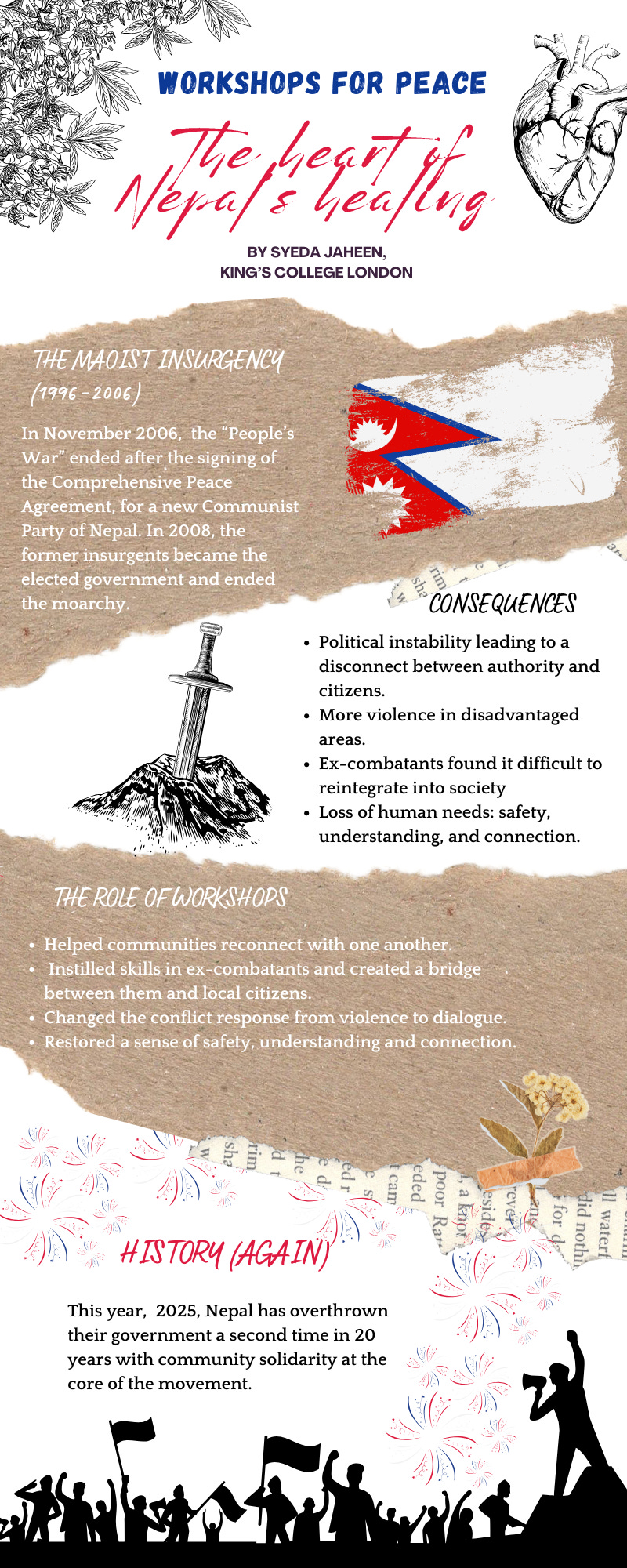
November 21st, 2006, marked the end of a decade-long civil war. The Maoist Insurgency in Nepal began in 1996, launching the “people’s war” against the government and monarchy after failed negotiations (Human Rights Watch, 2004). Ten years later, the armed conflict ended after the signing of the Comprehensive Peace Agreement, and the emergence of the Communist Party of Nepal (Lunn, 2013). In 2008, the former insurgents formed a democratic party that became the elected government and formally abolished the monarchy.
However, the end of the conflict was not the end of the struggles for Nepalese communities. Wars do not happen without a trace, and certainly do not disappear without one either. Long-term political instability has many consequences, including fragile political structures, corruption, and socio-economic struggles. One particularly overlooked consequence is the impact on citizens’ mental health and their social relationships (The New Humanitarian, 2013; Saud, 2025). The war may have ended, but the mark it left on the Nepalese psyche remained. Wars destroy more than landscapes and infrastructure; they impact the human spirit, depriving people of their human needs: safety, understanding, and connection (Acha, 2015).
Naturally, in 2006, peace was fragile in post-war Nepal, and the constant threat of hostility loomed over citizens. Disadvantaged communities were the most vulnerable to violence, as local socio-politics remained an adversary for peace (The Asia Foundation, 2024). Tension filled the air, with mistrust between neighbours, suspicion of socially isolated veterans, and further marginalisation of oppressed groups. Citizens who had only known violence for years had to learn to coexist. The fragmentation of these communities was not unusual in post-conflict societies, but threatened to rekindle conflicts over minor disputes. The people of Nepal could have continued to fall into these patterns. Instead, they rebuilt through community workshops, an unexpected, mundane but effective solution. For a post-conflict Nepal community, this was a step towards peace, trust, and stability. These spaces were dedicated to rebuilding their lost human needs; they became a place for education, reflection, and healing. Built on the determination of local citizens, fuelled by volunteers, these workshops became a beacon of hope for a country amidst chaos for a decade.
Preventing conflicts in local communities
In rural communities where the conflict was most active, war tensions remained high. Political differences and the trauma of armed conflict impacted the fabric of social relations. The Maoist Insurgency was a violent battle of ideology. The end of physical violence doesn’t mean the end of ideological warfare. Once over, violence does not cease to exist; instead, it slips into people’s minds. It enters conversations, household conflicts, neighbourhood disputes, and local politics. Soon, it fractures an already wounded community, causing divisions and spreading distrust. Consequently, it cultivates a culture where any dispute carries weight and escalates into open hostility. This fragile environment required an accessible solution that reshaped conflict resolution, helping these communities unlearn violence and embrace communication.
Community mediation workshops emerged to heal fragmented social relations with compassion and education. They brought together volunteers from local figures, including teachers, farmers, religious leaders, and most importantly, marginalised individuals like women and Dalits, to be trained mediators. NGOs such as The Asia Foundation launched these community mediation workshops to improve social relationships, tackle injustices, and promote diversity (Valters, 2016). Through dialogue exercises, role-play, and active listening, local citizens overcame post-war dynamics. The workshops were integrated into local governance with the introduction of the Village Development Committee (VDC). The goal was to create a space to tackle disputes and prevent escalation, with neutral third-party mediators trained by NGOs in peacebuilding (Valters, 2016). Although not suitable for all conflicts, such as highly criminal cases, these local centres attempted to address three key human needs: understanding, connection and safety. Instead of causing division through differences, they provided the tools and resources to empower citizens to resolve issues through conversation rather than violence (Valters, 2016).
Local Peace Committees (LPCs) were established throughout Nepal’s districts to secure and maintain peace at the micro level (Andries and Olivier, 2008). During Nepal’s transition to peace, these were essential to identify and navigate tensions in local communities psychologically affected by warfare, to coexist with political oppositions, successfully reducing violence (Andries and Olivier, 2008). Implementing these community-driven workshops faced obstacles, challenges, and failures; nevertheless, they demonstrated an active effort to give a voice to the voiceless. After a war, distrust of political figures is often high among marginalised communities, who may feel suspicion or distance from official government bodies. By creating neutral and community-led workshops, citizens received an accessible alternative to the traditional court, restoring safety and security in daily life. They nurtured these communities to harbour their connection, emphasising the importance of understanding. Peace was not restored immediately within the communal districts by radical government changes, but gradually through ordinary people’s efforts to overcome their struggles.
The return of former combatants to society
After the war, many ex-combatants didn’t receive the peaceful homecoming in a new, improved society that they expected. Instead, there was a mass demobilisation of thousands of young men and women into a society that was fearful, suspicious or resentful of them. Many had joined the People’s Liberation Army (PLA) at a young age, sacrificing their formative years of education and development to fight for a better tomorrow. Research involving 241 ex-PLA fighters reveals the ‘tomorrow’ they received was unemployment, social isolation and stigmatisation from a world that valued the education they sacrificed (Robins et al, 2016). Only a quarter of these ex-combatants returned to their original communities after being forced to relocate due to socio-economic reasons or political differences, seeking refuge with others who share their experiences (Robins et al, 2016). Hence, the war’s conclusion left them with a loss of community and purpose.
In this case, workshops set up by NGOs, LPCs, and ex-combatant networks aimed to heal the mental scars of war and reintegrate ex-combatants into society, promoting social belonging. It cultivated a unique space for veterans to share their experiences without judgment. They could express the conflicting experiences of war, reflecting on what they endured inside and outside the battlefield, giving them back a voice, which they had desperately wished for (Robins et al, 2016). By nurturing their sense of connection and belonging, the workshops addressed their loss of human needs and focused on communal healing after enduring shared trauma. One ex-combatant expressed relief in finding others who related to his struggles, explaining that it reduced his isolation (Robins et al, 2016).
For political and social integration, these workshops fulfilled veterans’ needs for understanding and connection by allowing them to reclaim their voice. One function was to enable these former soldiers to find new purposes, become educated, develop skills, and build a new life outside of combat, granting them the right to self-determination. They also set up coexistence workshops to promote understanding of ex-fighters’ perspectives to the wider community, including mixed groups or through a representative for the veterans (Robins et al, 2016). This allowed them to challenge misconceptions and reclaim dignity, encouraging society to no longer view these individuals in a one-dimensional way as former combatants but as neighbours, sons, daughters, and people. Restoring their self-esteem, providing reassurance that they were no longer byproducts of war and were free to be anyone they wished to be.
The impact of workshops
The echo of war lingered long after November 21st, 2006. Political instability from a decade of armed conflict, and even longer periods of political tension, couldn’t be easily erased. While restructuring the nation’s political sphere is usually the global focus, often, the collateral damage is the neglect of human needs. These workshops didn’t reverse all the consequences that emerged from war, and it would be unrealistic to expect them to counter decades of political animosity and neglect. Despite this, the workshops sought to restore citizens’ human needs. In retrospect, it did so much more by uniting citizens, promoting dialogue, not violence, and reshaping responses to internal conflict. It brought together groups, encouraging them to see eye-to-eye, from neighbours quarrelling over land to ex-combatants and their former communities. These workshops served various purposes, keeping the interests of overlooked, voiceless individuals at their core; working to restore citizens’ lost humanity and restore a sense of safety, understanding and connection. This symbolises the power of ordinary citizens and the peace they can achieve despite the odds.
This year, 2025, Nepal has successfully overthrown the government for the second time in 20 years through the ‘Gen Z Protests’ (Pokhare and Ellis-Petersen, 2025). Unlike 2006, this was not the work of an established insurgency but mainly a youth mobilisation. The unity of this moment did not come from nowhere; it was a result of decades of community peacebuilding after reconciliation in 2006 and represents hope for a better future for Nepal.
Reference list
Acha, D.K. (2015). The 7 Fundamental Human Needs | Servants University | Training Servants for Christ. Servants University. Available at: https://www.servantsuniversity.com/the-7-fundamental-human-needs/. [Accessed 3 November 2025].
Andries, G. and Olivier, J. (2008) Local Peace Committees in Nepal: Some Reflections and Lessons Learned. Kathmandu: Ministry of Peace and Reconstruction / GTZ.Available at: https://www.peaceinfrastructures.org/sites/g/files/zskgke471/files/Home%20Documents/Local%20Peace%20Committees%20-%20Some%20Reflections%20and%20Lessons%20Learned/Andries-Olivier_LCPsReflectionsNepal_2008.pdf [Accessed 4 Nov. 2025].
Human Rights Watch (2004). Nepal: Between a Rock and a Hard Place: II. Background. [online] Hrw.org. Available at: https://www.hrw.org/reports/2004/nepal1004/2.htm#_ftn6 [Accessed 3 November 2025].
Lunn, J. (2013) Nepal’s endless peace process, 2006–12. House of Commons Library, Standard Note SN04229, 11 October.
Pokhare, G and Ellis-Petersen, H. (2025). Unease at slow pace of change in Nepal one month on from gen Z protests. [online] the Guardian. Available at: https://www.theguardian.com/world/2025/oct/11/nepal-gen-z-protests-one-month-on-slow-change [Accessed 4 Nov. 2025].
Robins, S., Bhandari, R. and the ex-PLA Research Group (2016) Poverty, stigma and alienation: Reintegration challenges of ex-Maoist combatants in Nepal. Centre for Applied Human Rights, University of York. Available at: https://berghof-foundation.org/files/publications/Policy_brief_Ex_Maoist_Combatant_in_Nepal.pdf [Accessed 4 Nov. 2025].
Saud, N.B. (2025). The Art of Peace? Dêudã Culture and Its Role in Community ‘Peacebuilding’ in Nepal’s Far-western Communities.Available at: https://research.uca.ac.uk/6805/1/1.%20UCA_2109573_Saud_Nar_PhD%20_Thesis_Art-of-Peace_Deuda_2025-08-14_Final.pdf [Accessed 4 Nov. 2025].
The Asia Foundation. (2024). “From Divisiveness to Problem Solving: Harnessing the Power of Dialogue in Nepal.” AsiaFoundation70 - The Asia Foundation. Available at: https://asiafoundation.org/about/asiafoundation70/ [Accessed 5 Nov. 2025].
The New Humanitarian. (2013). Nepal’s post-conflict mental health needs neglected. Available at: https://www.thenewhumanitarian.org/analysis/2013/12/12/nepal-s-post-conflict-mental-health-needs-neglected? [Accessed 3 November 2025].
Valters, C (2016). Building justice and peace from below? Supporting community dispute resolution in Asia.Kathmandu: The Asia Foundation.Available at https://asiafoundation.org/wp-content/uploads/2024/08/Building-Justice-and-Peace-from-Below.pdf [Accessed 3 November 2025]
In this episode Syeda discusses the Nepalese experience of using workshops as a community healing tool post conflict. She is a Citizen journalist with us on a placement organised with Department of War Studies, KCL. This article was edited using Lex.page.
Thank you for reading an A4R 🎨 Post. Don’t forget to visit our gift shop here. Every purchase scales our impact and pays our bills.


